
Published · 2026-10-18
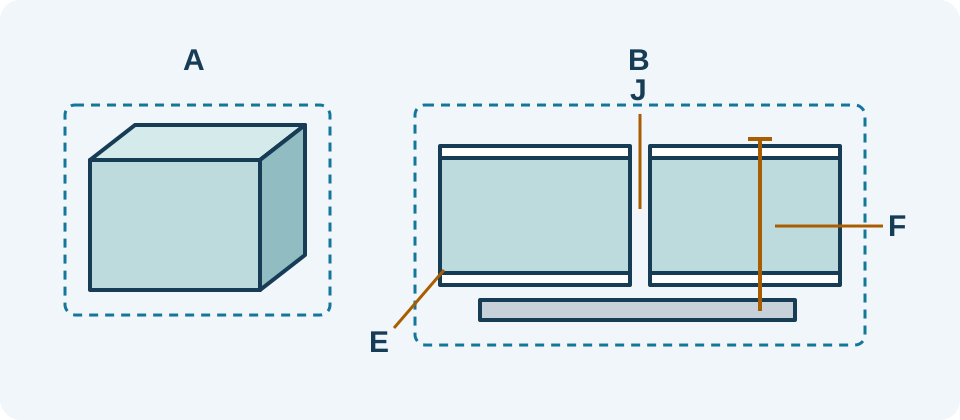
- A: Identify the material or specimen covered by its document.
- B: Request the drawing defining the complete assessed construction. Dashed outlines only illustrate the question about the assessment boundary.
- J / F / E: Ask whether joints, fixings, supports and edges are included. Their positions are fictional.
Original conceptual diagram, not to scale. No actual ZY panel build-up, dimensions, thermal-bridge calculation, heat-flow path or performance is shown. Colours and relative sizes carry no thermal value; the applicable method and actual construction require project review.
Keep the property beside the number
Copy the property name and complete unit from the document. Conductivity, commonly written λ, uses W/(m·K). Building R-values are area-based resistance values, commonly expressed in m²·K/W; NIST lists this unit under thermal insulance, separately from resistance in K/W. A U-value represents thermal transmittance and is commonly expressed in W/(m²·K). These are different properties: do not put their bare numbers into one ranking column. [1] [4] [5]
Match the reported boundary
Material evidence and an assembly result need different descriptions. Ask whether the submission covers a core specimen, a defined panel section or the proposed wall or roof assembly. Request the drawing identifying what is included. Australian Government insulation guidance distinguishes material and total assembly R-values and identifies thermal bridges as heat-transfer paths that bypass insulation. This is useful comparison context, not a specification for a ZY product. [2]
Ask which conditions the value represents
Record the declared or design-value basis, the stated temperature and moisture conditions, and the referenced method and edition. The public abstract of ISO 10456:2007 addresses declared/design values and condition conversions for thermally homogeneous materials and products. Do not apply an unexplained conversion to a complete panel or assume two differently conditioned values are equivalent. [3]
Do not assume every calculation covers every joint
Request the joint, fixing, support and edge assumptions used in the assessment. The public scope of ISO 6946:2017 includes exclusions and distinguishes a metal-fastener correction from other metal-bridged cases outside its scope. Ask the project reviewer whether the proposed method suits the actual geometry. This guide does not supply an engineering calculation or determine the project's required standard edition. [4]
Resolve a mismatch before comparing prices
Illustrative example, not a ZY quotation: offer A supplies a core conductivity result; offer B supplies an assembly transmittance result. The panel joints and assessment boundaries are not matched. Keep both submissions in separate property columns and request the missing configuration and method information. Let the project reviewer decide what comparable evidence is required. Neither printed number alone proves project acceptance.
Thermal evidence comparison record
- Project, destination, intended use and responsible reviewer
- Quoted configuration, core, thickness, faces and drawing revision
- Reported property, numerical value and complete unit
- Assessment boundary and drawing showing included components
- Test/calculation method, edition, report identifier, date and revision
- Declared or design-value basis and referenced conditions
- Temperature, moisture and other stated conditioning assumptions
- Joint, fixing, support and edge details included or excluded
- Thermal-bridge treatment and method suitability confirmation
- Match between the documented construction and the offered product
- Separate air/vapour interface or condensation review required by the project
- Missing answers, responsible party, response date and reviewer decision
Download comparison record (TXT)
Send the panel schedule and available thermal documents with your enquiry. Confirm what evidence can be supplied for the proposed construction. This record does not establish a ZY thermal value, recommend a panel thickness, calculate energy savings or guarantee condensation-free operation.
Related products and enquiries
Sources and scope
Sources rechecked on 18 October 2026. NIST is used for units; YourHome is Australian residential guidance; ISO references are public abstracts only. The comparison workflow and mismatch example are editorial guidance. Confirm project requirements and document applicability with the responsible reviewer. The DOE residential-window reference is used only to identify U-factor as thermal transmittance; its purchasing rules, numerical requirements and savings examples are not applied to panels.