
Published · 2026-10-17
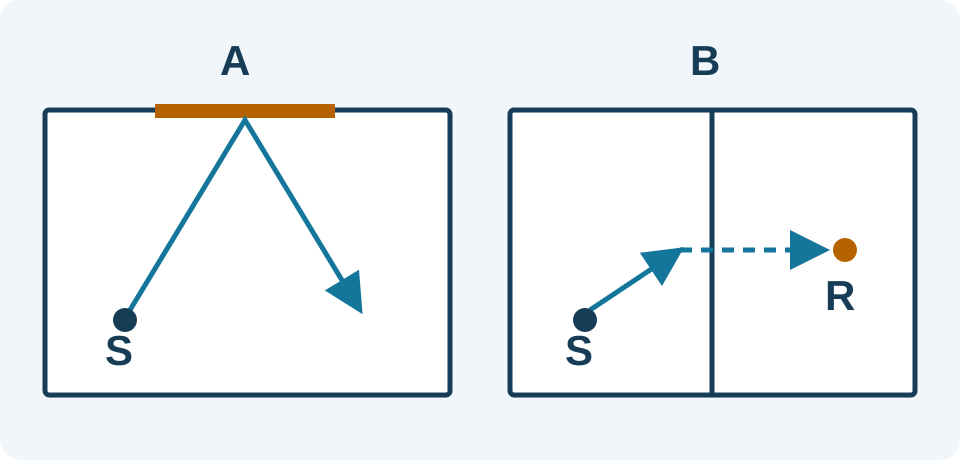
- A: Review reflections within one room when defining an absorption objective. The highlighted surface is only a surface under consideration.
- B: Review the source and receiving spaces when defining an insulation objective. The dashed arrow marks a possible transmission path to investigate.
- S: sound source. R: receiving location.
Original conceptual diagram, not to scale. Symbolic paths distinguish purchasing questions; they are not measured sound levels, absorption ratios, a complete transmission model, a tested assembly or installation instructions. Arrow size and surface colour carry no performance value. Flanking paths and other interfaces still require project review.
An enquiry for an acoustic panel needs a defined problem. Are you treating sound within one room, limiting sound passing into another space, or asking for both? Record the objective before comparing product names or prices. This guide offers purchasing questions; it assigns no acoustic rating to any ZY panel.
Start with the sound path
Absorption addresses reflections within a room; insulation concerns sound passing between spaces. [1] On the plan, mark the source, the receiving space and the surfaces under consideration. Ask the project acoustic designer to identify which requirement applies to each wall, ceiling or enclosure.
Ask for the relevant evidence
ISO 354:2003 concerns reverberation-room absorption measurements. [2] ISO 10140-2:2021 concerns laboratory airborne sound insulation of building elements. [3] Ask the supplier to name the measured property, test method and report reference. An absorption report does not, by itself, establish the insulation of a partition.
Compare the quoted build-up with the specimen
Request a description of the proposed faces, core, thickness, joints, backing, cavity and mounting. Place it beside the report's specimen description and record differences for review. A similar core name or panel photograph does not establish that two assemblies have equivalent acoustic results.
Keep laboratory results and the finished building separate
Laboratory insulation results need additional consideration before use on site, including flanking transmission. [3] Give the designer the proposed junctions, doors, glazing and service openings. Ask who reviews these interfaces and what site verification the project requires; do not convert a laboratory figure into a guaranteed room-to-room outcome.
Compare two incomplete offers
Illustrative procurement scenario: offer A says acoustic panel without an identified report; offer B names a report and describes its specimen. Ask A for evidence and ask B whether the quoted construction matches the tested one. B's extra detail improves traceability; it does not establish project suitability or make the comparison complete.
Close the enquiry without inventing a target
Provide the project location, drawing revision, panel marks, areas, dimensions and requested delivery programme. Have the responsible designer specify the acoustic metric, target and acceptance process. Request fire, structural, moisture and cleaning requirements separately. Mark unconfirmed matters for review rather than supplying an assumed rating or delivery date.
Separate measurement from rating in the report register
A test method identifies what was measured; a rating method identifies how results are summarised. Keep both references when supplied. Do not treat four standard numbers as four interchangeable acoustic approvals.
| Report task | Reference and scope | Record before comparison |
|---|---|---|
| Absorption measurement | ISO 354:2003 — reverberation-room absorption [2] | Specimen, mounting and frequency results |
| Absorption rating | ISO 11654:1997 — rating of sound absorption [4] | Exact stated rating and underlying measurement report |
| Airborne insulation measurement | ISO 10140-2:2021 — laboratory airborne insulation [3] | Full element build-up and measurement report |
| Airborne insulation rating | ISO 717-1:2020 — single-number airborne insulation rating [5] | Exact named quantity and associated measurement reference |
Use one row in the comparison register for each proposed assembly. If only a rating page is supplied, request the measurement report and specimen details. If a measurement report is supplied without the metric required by the project, ask the acoustic reviewer what further evaluation is needed. Do not calculate a substitute rating from the product name.
Acoustic evidence enquiry checklist
- Project location, building use and responsible acoustic reviewer
- Objective: room absorption, separation between spaces, or both
- Source and receiving spaces marked on the current drawing
- Required acoustic metric, target, test method and acceptance responsibility
- Panel marks, quantities, dimensions and units; drawing revision
- Proposed faces, core, thickness, backing, cavity and mounting
- Report issuer, reference, date and tested specimen description
- Differences between quoted assembly and tested specimen
- Joints, perimeter connections, doors, glazing and service openings
- Design review and any required site-verification scope
- Separate fire, structural, moisture and cleaning requirements
- Included supply and installation, requested programme and matters to confirm
- Measurement method and report reference, recorded separately from rating method
- Exact reported acoustic quantity and applicable frequency data or rating page
Mark unknown details To confirm. This checklist sets no product rating, approved design or delivery commitment.
Download the editable evidence checklistRelated acoustic products
Sources and scope
Sources rechecked on 17 October 2026. ISO references describe public catalogue scopes, not full licensed standards. Rockfon explains terminology, not ZY product performance. Procurement guidance, not industry news or design approval.