
Published · 2026-10-15
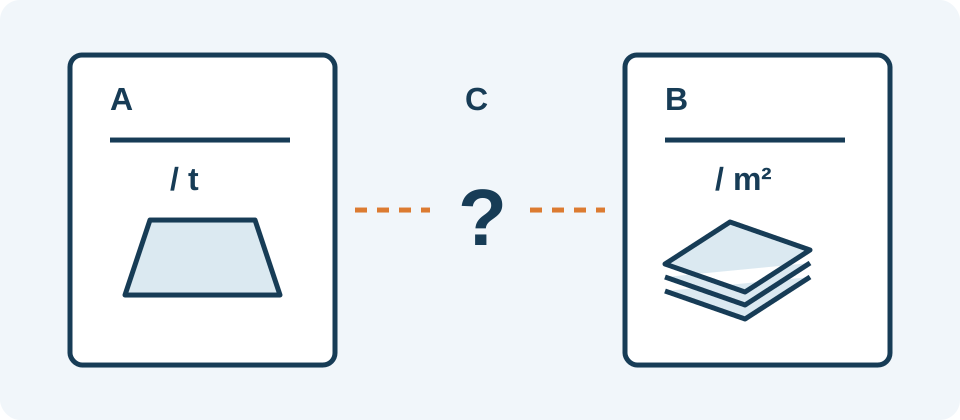
- A — Offer A: result per tonne
- B — Offer B: result per square metre
- C — Review product, unit and life-cycle scope before comparison
Original conceptual diagram, not to scale. A and B are fictional offers. Icons show different quantity bases, not dimensions or carbon values; no ranking or accepted conversion is shown.
Start with the actual document
An Environmental Product Declaration (EPD) reports life-cycle environmental information; possessing one does not itself establish environmental superiority. Ask for the complete declaration and its programme-library entry, rather than a logo or a screenshot of one result. Record the holder, registration number, version, dates and current status. [2]
Check the edition and current status
EPD International announced ISO 14025:2026 on 30 June 2026. Record the standard edition and programme rules used by the supplied declaration. This update alone does not tell you whether an older declaration remains acceptable for a particular project. Ask the programme operator and project reviewer about its status and applicable transition arrangements. [1]
Map the declared product to the quoted panel
Create one row for each proposed configuration: core, thickness, metal faces, coating, joint and intended use. Ask which row the declaration covers, including manufacturing scope and any product-group or representative-product assumptions. Record the relevant Product Category Rules (PCR), version and any applicable complementary rules. Do not extend a document for one component to the complete assembled panel without evidence. [3]
Agree the basis before comparing figures
As a purchasing check, record the declared or functional unit, impact indicator, calculation-method version and included life-cycle stages exactly as reported. Keep module labels, exclusions and scenarios with their values. Ask the reviewer whether the two datasets can support the same project decision. A production-stage result is not a whole-building result; assess the construction context separately. [4]
Use a mismatch example to expose missing information
Illustrative example, not a ZY quotation: offer A reports an impact per tonne, while offer B reports per square metre. Their panel thicknesses and configurations have not been matched. Do not rank the offers from the printed numbers. Request the product mapping and quantity basis needed by the reviewer; document any permitted conversion and its assumptions. Mark the comparison unresolved if the inputs remain missing.
Keep environmental review beside technical review
Route structural, fire, thermal, hygiene and installation requirements through their own evidence checks. An EPD is not a substitute for those reviews. Agree who checks the environmental submission, which files enter the project assessment and how revisions are recorded. This worksheet organises a request; it does not calculate carbon, authenticate a declaration or establish acceptance.
Enquiry checklist
- Project, destination, intended use and responsible reviewer
- Quoted panel configuration, quantity and drawing revision
- Declaration holder, registration number and programme-library URL
- Declaration version, dates and status checked on a recorded date
- Declared product, manufacturing scope and coverage of each quote row
- Standard edition, PCR version and applicable complementary rules
- Declared or functional unit and proposed quantity or conversion basis
- Impact indicators, method version, life-cycle stages and exclusions
- Project scenarios, technical performance requirements and separate evidence
- Missing information, reviewer decision, agreed revisions and submission stage
Send the panel schedule and the requested document list. Ask what evidence is available for the proposed configuration. This guide does not claim that a ZY product already has an EPD or a verified carbon value.
Download editable checklistRelated products and enquiries
Sources
Programme information and building-assessment context, checked 15 October 2026. Procurement workflow and the mismatch example are editorial guidance. No complete paid standard or project-specific declaration was assessed.
Sources rechecked on 15 October 2026. Procurement guidance, not a new industry event.
[1] EPD International — ISO 14025:2026
[2] EPD International — EPD information