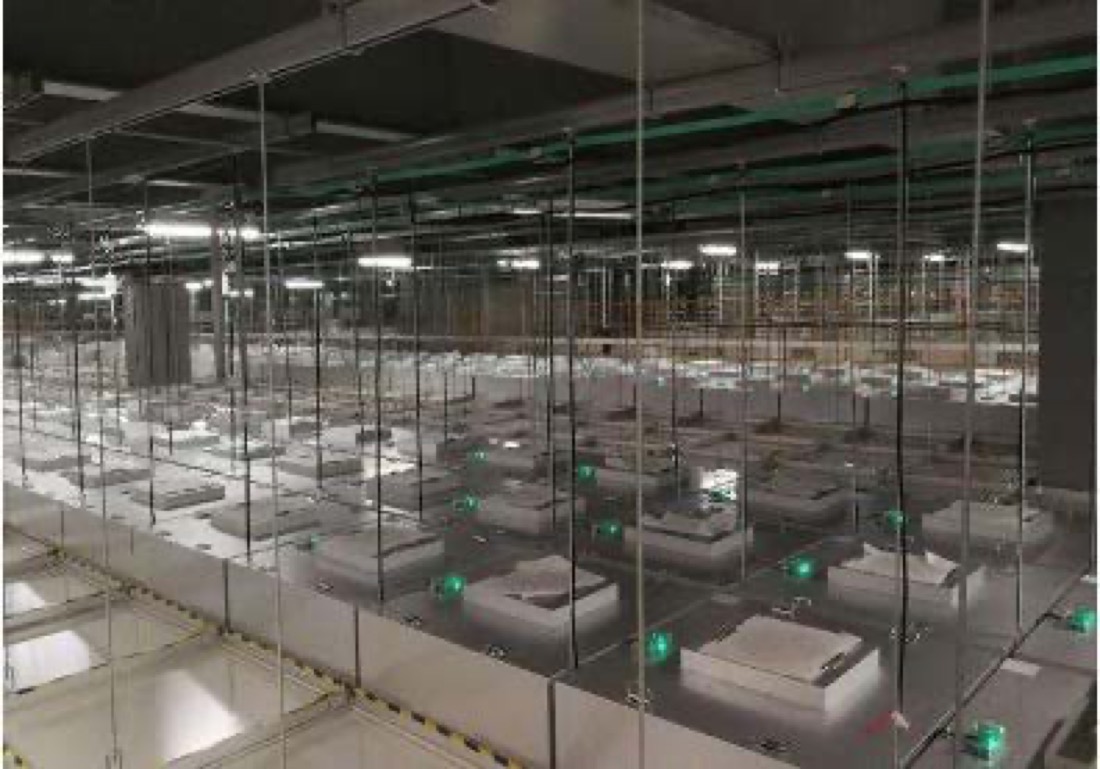
FFUs and HEPA Filters for Cleanrooms
An FFU combines a fan and a filter in one ceiling-mounted unit. This page also covers HEPA terminal housings and cleanroom filters, from pre-filters to HEPA and ULPA. Buyers are cleanroom designers, HVAC contractors and maintenance teams. We supply FFUs and filters in the same quotation as the panels and ceiling grid, so opening sizes match. FFUs and filters are bought in and checked before shipping.
Best for
- Cleanroom ceilings fitted with FFU grids
- Rooms served by ducted HEPA terminal housings
- Filter replacement in existing HVAC systems, FFUs and housings
- Local airflow equipment such as movable laminar-flow carts
Specifications
Typical specification
| FFU | Fan and filter in one unit, mounted in the ceiling grid |
|---|---|
| Ducted HEPA terminal housing | No fan; takes air from the air-handling system through a duct |
| Other air equipment | Movable laminar-flow carts, pneumatic isolation dampers, bag-in/bag-out housings |
| Filter families | Panel pre-filters; bag and W-type medium-efficiency; mini-pleat, separator, gasket-seal, gel-seal and high-temperature HEPA; mini-pleat ULPA |
| HEPA H13 | 99.95% minimum integral efficiency at MPPS (EN 1822 class reference, not a ZY test result) |
| HEPA H14 | 99.995% minimum integral efficiency at MPPS (EN 1822 class reference, not a ZY test result) |
| FFU quote inputs | Dimensions and mounting, airflow at the stated resistance, filter class, voltage and frequency, control interface |
| Filter quote inputs | Type, outer dimensions and depth, rated airflow, initial and final pressure drop, class and standard, seal type, housing drawing, operating temperature |
| Standards named | EN 1822 (H13, H14); ISO 29463-1:2024 (high-efficiency filters); ISO 16890-1 (general-ventilation filters) |
Options
What you can specify
- FFU or ducted HEPA terminal housing
- Gasket-seal or gel-seal HEPA filter
- H13 or H14 HEPA, or ULPA
- High-temperature HEPA filter
- Panel pre-filter, bag or W-type filter
- FFU motor control mode, confirmed for the offered model
How to choose
Decide where the air is made. An FFU has its own fan. A ducted terminal housing has none, so the upstream fan, duct and available pressure must be set in the project design. H14 has a higher minimum efficiency than H13 at the most penetrating particle size (MPPS). MERV 13 and H13 are different classifications and are not interchangeable.
A filter grade or an FFU does not give a room its ISO class. The room design, HVAC system, installation and testing do.
EN 1822 classes in one table
| EN 1822 class | Overall efficiency, at least | Local efficiency, at least | Nearest ISO 29463 class |
|---|---|---|---|
| E11 | 95% | None set | ISO 15 E |
| E12 | 99.5% | None set | ISO 25 E |
| H13 | 99.95% | 99.75% | ISO 35 H |
| H14 | 99.995% | 99.975% | ISO 45 H |
| U15 | 99.9995% | 99.9975% | ISO 55 U |
Values are at the most penetrating particle size. A US-style figure of 99.97% at 0.3 µm is a different test, so ask which test a quotation uses. Full table: HEPA and ULPA filters guide.
FFU data sheet: what to ask every supplier for
A Lawrence Berkeley National Laboratory test of 20 commercial FFUs (LBNL-55039, 2004) found energy performance differed considerably between units. Its test method measures five things. Use them as the headings of your FFU data sheet:
1. Total electric power at your duty point 2. Total pressure efficiency 3. Airflow rate 4. Pressure difference across the unit 5. Airflow uniformity across the filter face
Add noise at the duty point with the test distance stated, and the speed control and monitoring interface.
For unidirectional flow, FDA's 2004 aseptic guidance gives 0.45 m/s ±20%, and EU GMP Annex 1 para 4.30 gives 0.36 to 0.54 m/s at the working position as a guidance value. Ask for measured face velocity, not only airflow.
Gel seal or gasket seal?
| Gel seal | Gasket seal | |
|---|---|---|
| Housing | Needs a knife-edge housing | Needs a flat sealing face |
| Check on site | Knife edge sits fully in the gel | Gasket position and compression |
| Swap one for the other | Not without changing the housing | Not without changing the housing |
Leak test after installation
A filter class rates the filter. A leak test proves the installed filter and its seal. ISO 14644-3:2019 clause B.7 sets out the method. EU GMP Annex 1 para 4.25 asks for an installed filter leak test at qualification. Leave test access for each filter. See HEPA leak testing.
What to specify in an enquiry
For FFUs, send the unit dimensions and mounting, the airflow at the stated resistance, filter class, voltage and frequency, the speed control or monitoring interface, and quantity. State noise test conditions if noise matters. For filters, send the type, outer dimensions and depth, rated airflow, initial and final pressure drop, the standard and class, seal type, housing drawing, operating temperature and the test reports you need.
Quote checklist
| For FFUs | For replacement filters |
|---|---|
| Unit size and ceiling grid module | Outer dimensions and depth |
| Airflow at stated resistance | Rated airflow |
| Filter class (EN 1822 or ISO 29463) | Class, standard and test |
| Voltage, frequency, motor type | Initial and final pressure drop |
| Control mode and monitoring interface | Seal type and housing drawing |
| Noise target with test distance | Operating temperature |
| Quantity and ceiling layout | Photos of the label on the old filter |
What goes wrong on site
Gel-seal filters need a knife-edge housing, and gasket filters need the gasket position and compression checked. Do not swap one for the other without checking the housing. Adding FFUs to an existing room is not a plug-in job: check the ceiling structure, airflow balance, returns, power and controls first.
An EC motor or speed control alone does not mean constant airflow. Specify the control mode and the airflow you need.
Fan filter unit selection: fan type, noise, control and sizing
Questions
Common questions
What is the difference between H13 and H14?
H14 has a higher minimum integral efficiency than H13 at the most penetrating particle size. The EN 1822 class references are 99.95% for H13 and 99.995% for H14. These are class references, not test results for a ZY product.
What is the difference between an FFU and a ducted HEPA terminal housing?
An FFU has its own fan and filter in one unit and is mounted in the ceiling grid. A ducted terminal housing has no fan. It takes air from the air-handling system, so the upstream fan, duct connection and available pressure must be defined in the project design.
Will FFUs or HEPA filters make my room meet an ISO class?
Not by themselves. The room class depends on the complete room design, the HVAC system, installation and validation. Treat the equipment as components of that design.
How many FFUs does the project need?
The system designer determines this from the room layout, process, particle-control target, operating state and environmental loads. An ISO class alone is not a fixed air-change rate or FFU count.
Is MERV 13 the same as H13?
No. MERV 13 is an HVAC filter rating across particle-size ranges. H13 is an EN 1822 HEPA class at the most penetrating particle size. The shared number does not make them interchangeable.
Can you supply replacement filters for an existing housing?
Yes, from the filter's outer dimensions, depth, seal type, rated airflow and class. Send the housing drawing or photos of the old filter label. Filters are bought in and checked before shipping.
Project enquiry
Send what you have
A room list, a floor plan or only the floor area is enough to start. After you submit, send drawings by email or WhatsApp.
We reply by email within one working day. We can sign an NDA before you send drawings.
WhatsApp +44 7962 561184 is our UK number for export enquiries. The factory is in Tianjin, China.
Email: [email protected]
WhatsApp: +44 7962 561184