Buyer guide
HEPA filter integrity and leak testing
An integrity test finds leaks in an installed HEPA filter by releasing aerosol upstream and scanning the clean side with a probe. FDA treats one reading of 0.01% of the upstream challenge as a significant leak.
By ZY Cleanroom · Updated · Sources at the end of the page
Leak test or efficiency test
FDA describes an intact HEPA filter as retaining at least 99.97% of particles larger than 0.3 µm. That figure comes from an efficiency test, which rates the filter. It is not meant to find leaks.
| Test | What it answers | How |
|---|---|---|
| Efficiency | Is the filter media up to its rating? | Monodispersed 0.3 µm aerosol, reading averaged over the whole face |
| Leak (integrity) | Is there a leak in the media, frame or seal? | Polydispersed submicron aerosol, in place, probe scan of the clean side |
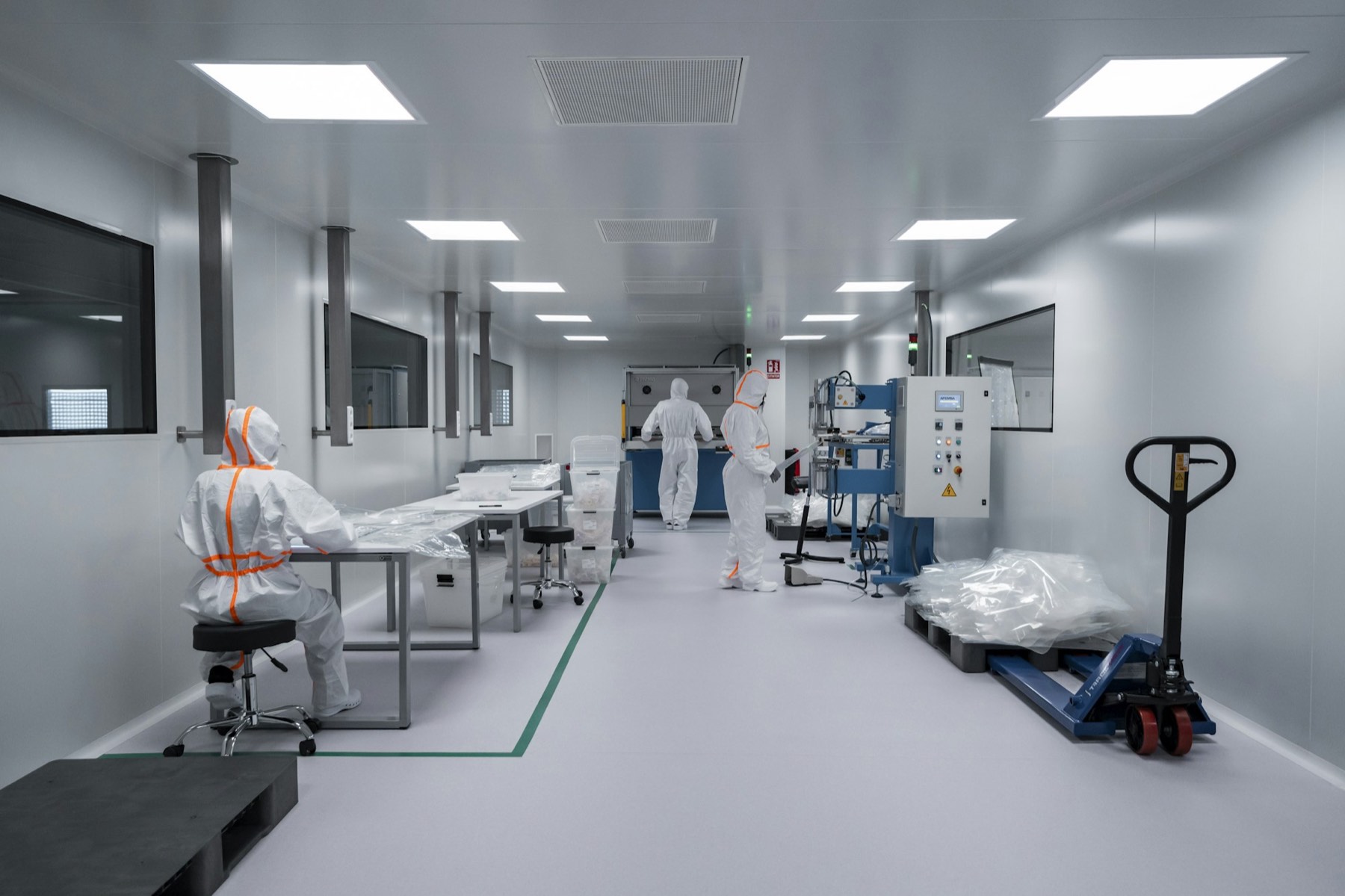
How the scan works
FDA says the same broad principles apply to ULPA filters. It names DOP and PAO as example aerosols. The concentration upstream must suit the accuracy of the photometer. The probe samples at least one cubic foot per minute, about 28 litres. It scans the whole filter face and frame, about 1 to 2 inches (2.5 to 5 cm) from the face.
The downstream reading is calculated as a percent of the upstream challenge. One probe reading of 0.01% means a significant leak. The filter is replaced, or a limited area is repaired and retested. The scan must be documented.
Two methods in HTM 03-01
| Method | Leak criterion (HTM 03-01) |
|---|---|
| Dispersed oil particles and photometer (para 11.61) | A steady, repeatable reading above 0.01% of the upstream reading |
| Light-scattering particle counter, natural challenge (para 11.60) | A significant number of particles at or above the smallest non-penetrating size |
Set the instrument
HTM 03-01 (para 11.59) asks that the upstream challenge is measured in both methods. A reading through a representative piece of filter media sets the background level. The two readings set the instrument's range. For acceptance, HTM 03-01 (para 12.63) defines a leak as a significant, repeatable rise above background.
Example: what 0.01% means
Example only, plain arithmetic. If the upstream challenge reads 1,000 units on the photometer, 0.01% is 0.1 unit. A steady reading of 0.1 or more at the probe is a leak. Your protocol sets the actual limit.
When to test
| Trigger | Source |
|---|---|
| Qualification of the room | Annex 1, para 4.25: installed filter leakage and integrity |
| Requalification: every 6 months for grades A and B, 12 months for C and D | Annex 1, para 4.32 (maximum intervals) |
| After a change of final filters or other remedial action | Annex 1, para 4.32 |
| At installation, then twice a year as an example for an aseptic room | FDA, 2004 |
| Poor air quality, renovation near ceilings or walls, a media fill or sterility failure | FDA, 2004 |
Design for the test
HTM 03-01 (para 8.102) asks for final filters in a leak-proof housing that allows the unit, filters and seals to be validated. Put test access in the room data sheet: upstream injection point, scan access to the clean side, acceptance limit and who tests.
FDA also lists filters in dry heat depyrogenation tunnels and ovens among those to leak test. It allows alternate methods in the hot zones where justified. FDA adds that leak testing alone does not monitor filter performance. Velocity uniformity across the filter also matters. The drug manufacturer stays responsible for defining the test methods and acceptance criteria, even when a contractor tests.
Who approves the room
Your regulator or customer auditor judges the facility, not the contractor. To have a room list reviewed, send it to ZY Cleanroom, a cleanroom design-and-build contractor.
Questions
Common questions
What is the leak limit for a HEPA filter?
FDA and HTM 03-01 both give 0.01% of the upstream challenge on a photometer scan. Your protocol sets the limit that applies to your room.
How often should HEPA filters be leak tested?
Annex 1 sets a maximum of 6 months for grades A and B and 12 months for C and D. FDA gives twice a year as an example for an aseptic room.
Can a leaking filter be repaired?
FDA allows repair in a limited area when appropriate, followed by a retest of that area. HTM 03-01 says a failed filter is replaced, and a failed seal or housing may be repaired.
Is a leak test the same as an efficiency test?
No. An efficiency test rates the filter media. A leak test scans the installed filter, frame and seal for leaks.
Related guides
- ISO 5 and ISO 6 cleanroom requirements
- FFU ceiling layout: coverage, class and grids
- EU GMP grades A to D compared with ISO classes
- Cleanroom temperature and humidity requirements
- Turnkey cleanroom contractor
- Room list builder
Sources
- FDA, Guidance for Industry: Sterile Drug Products Produced by Aseptic Processing, Current Good Manufacturing Practice (September 2004, nonbinding; checked 31 October 2026)
- EudraLex Volume 4, Annex 1: Manufacture of Sterile Medicinal Products (published 25 August 2022, applied from 25 August 2023; checked 31 October 2026)
- NHS England, Health Technical Memorandum 03-01, Specialised ventilation for healthcare premises, Part A (published 22 June 2021; checked 31 October 2026)
Project enquiry
Send what you have
A room list, a floor plan or only the floor area is enough to start. After you submit, send drawings by email or WhatsApp.
We reply by email within one working day. We can sign an NDA before you send drawings.
WhatsApp +44 7962 561184 is our UK number for export enquiries. The factory is in Tianjin, China.
Email: [email protected]
WhatsApp: +44 7962 561184