Buyer guide
Cleanroom temperature and humidity requirements
ISO cleanroom classes set no temperature or humidity, so your process, your people and your sector standard decide them. Published ranges include 20 to 24 °C and up to 60% RH for UK pharmacy aseptic suites, and 20 to 24 °C with 20 to 60% RH for US operating rooms.
By ZY Cleanroom · Updated · Sources at the end of the page
Published ranges
These are design values from the documents named. Check the current edition.
| Application | Temperature | Humidity | Source |
|---|---|---|---|
| UK pharmacy aseptic suite, gene therapy clean room | 20 to 24 °C | Floating, max 60% RH | HTM 03-01, Table 6 |
| UK isolation and critical care rooms | 20 to 25 °C | Floating, max 60% RH | HTM 03-01, Tables 3 and 4 |
| US operating room | 20 to 24 °C | 20 to 60% RH | ASHRAE 170, Table 7-1 |
| India operation theatre | 21 ± 3 °C; 18 ± 2 °C for joint replacement | 20 to 60% RH | NABH, 2018 |
| EU GMP sterile and ATMP rooms | No value set | No value set | Annex 1 para 9.6; Part IV para 4.11 |
| Electronics, ESD control | Not stated in the source | Not required by ANSI/ESD S20.20 | EOS/ESD Association, 2024 |
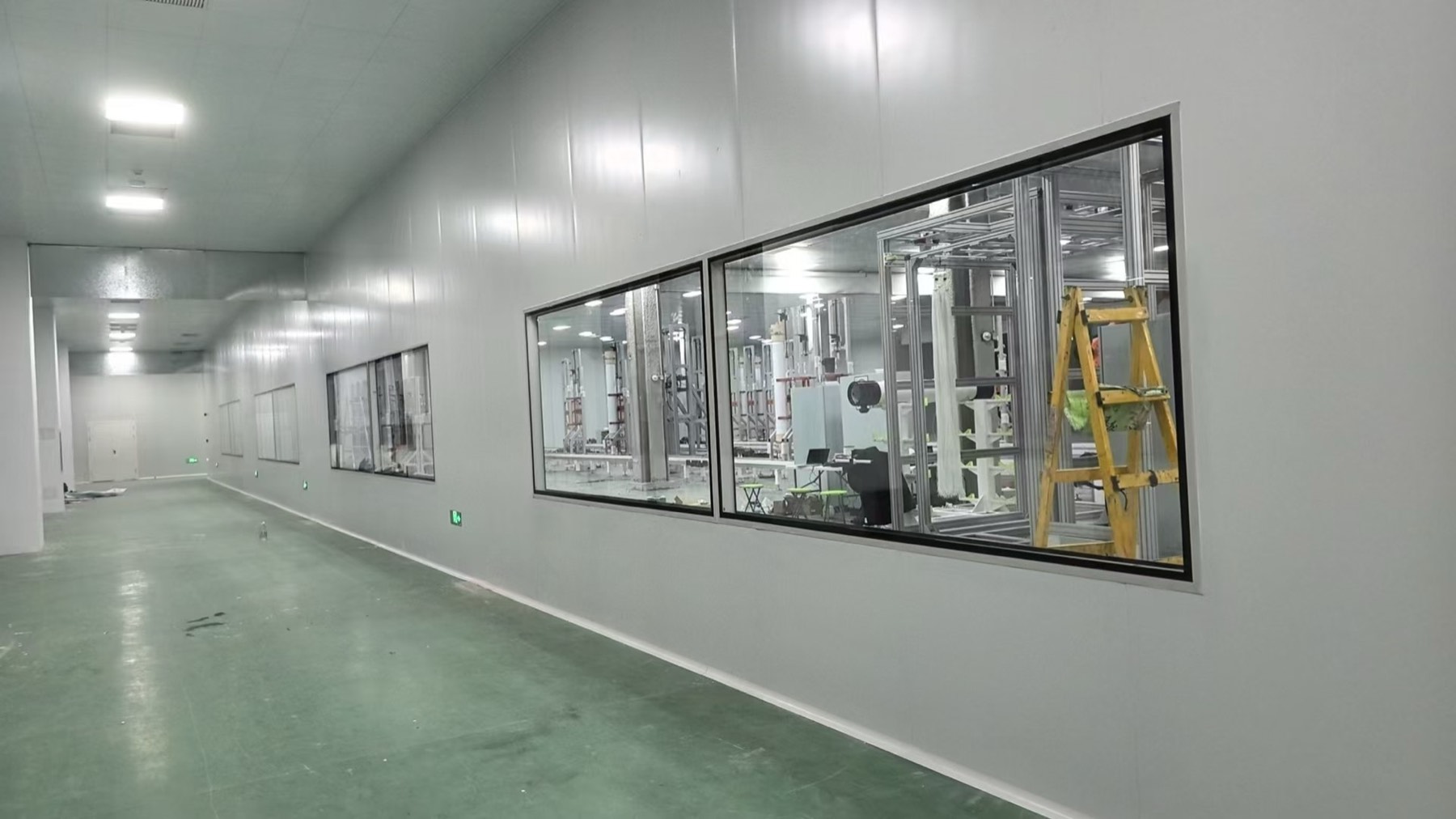
What the standards actually say
Annex 1 para 9.6 asks that temperature and relative humidity be controlled within ranges that suit the product, process and personnel and support the defined cleanliness. Para 4.25 lists temperature and humidity tests in qualification.
EU Part IV for ATMPs asks that lighting, temperature, humidity and ventilation suit the activity and not harm the product or equipment (para 4.11).
For static control, the ESD Association says ANSI/ESD S20.20 does not rely on humidity. Items are typically qualified at 12% ± 3% RH and 23 ± 3 °C. Humidity helps but does not control charge, so grounding still matters.
Dew point and condensation
A surface colder than the air's dew point gets wet. Chilled pipes, cold glazing and uninsulated duct are common cases. The table is calculated with the Murphy and Koop (2005) vapour pressure formula for liquid water.
| Room temperature | Dew point at 30% RH | at 45% RH | at 60% RH |
|---|---|---|---|
| 20 °C | 1.9 °C | 7.7 °C | 12.0 °C |
| 22 °C | 3.6 °C | 9.5 °C | 13.9 °C |
| 24 °C | 5.4 °C | 11.3 °C | 15.8 °C |
Worked example: heat sets airflow
Example only, with assumed values. Equipment gives off 5 kW. Supply air is 8 K cooler than the room. Air is 1.2 kg/m³ with a specific heat of 1.006 kJ/(kg·K).
Airflow equals heat divided by density, specific heat and temperature difference: 5 ÷ (1.2 × 1.006 × 8) = 0.52 m³/s, or about 1,860 m³/h. In a 120 m³ room that is 15.5 air changes per hour. Heat alone can set the airflow, so state the heat load in the room data sheet.
Worked example: removing moisture
Example only, calculated at 101,325 Pa. Make-up air at 24 °C and 60% RH holds 11.2 g of water per kg of dry air. Room air at 22 °C and 45% RH holds 7.4 g/kg. The difference is 3.8 g/kg.
Take the 0.52 m³/s above as the make-up flow, which is 0.62 kg/s of air. Removing 3.8 g/kg takes out about 2.4 g/s, or 8.5 kg of water per hour. This is the water only. It excludes the cooling energy.
How to write it down
State the set point, the tolerance, the measuring position, the room state and the alarm limits. Example only: 22 ± 2 °C and 30 to 60% RH at 1.5 m above floor, at rest and in operation, trended.
Give a separate target for the process if it needs one. UK guidance puts these rooms under building management system control.
Who approves the room
Your regulator or customer auditor judges the facility, not the contractor. The contractor builds to your room data sheet and supplies test data. To have a room list reviewed, send it to ZY Cleanroom, a cleanroom design-and-build contractor with its own panel factory in Tianjin, China.
Questions
Common questions
What temperature does an ISO 7 cleanroom need?
ISO 14644-1 sets none. UK guidance gives 20 to 24 °C for pharmacy aseptic suites. Your process sets the rest.
What humidity should I specify?
UK pharmacy guidance gives a maximum of 60% RH. US operating rooms use 20 to 60%. Write the band your process needs.
Does humidity change the particle class?
ISO 14644-1 classifies by particle count only. Annex 1 still lists humidity tests in qualification.
Is low humidity a problem for ESD?
The ESD Association says S20.20 does not rely on humidity. Ground people and equipment and qualify items at low RH.
What temperature and humidity does USP 797 require?
Massachusetts board guidance on USP <797> puts the cleanroom suite at 20 °C or cooler and below 60% relative humidity, to limit microbial growth. USP's December 2023 FAQ says a segregated compounding area has no specific limits, and that those rules sit with the state board. Check your own regulator's current text before you fix the design values.
How do temperature and humidity control affect cleanroom operating costs?
Tighter limits cost more to run, because the air must be cooled, dried, reheated or humidified for more of the year. A low dew point adds work, since air must be cooled further or dried by a separate system. Write down the band your process really needs, not the narrowest one on offer.
Related guides
- EU GMP grades A to D compared with ISO classes
- HEPA filter integrity and leak testing
- Cleanroom pressure alarm: how to find the cause
- ISO 5 and ISO 6 cleanroom requirements
- Turnkey cleanroom contractor
- Room list builder
Sources
- NHS England, Health Technical Memorandum 03-01, Specialised ventilation for healthcare premises, Part A (published 22 June 2021; checked 31 October 2026)
- ANSI/ASHRAE/ASHE Addendum y to Standard 170-2025, Ventilation of Health Care Facilities, Table 7-1 (approved 22 September 2026; checked 31 October 2026)
- NABH, Revised Guidelines for Air Conditioning in Operation Theatres (issue 4, November 2018; checked 31 October 2026)
- EudraLex Volume 4, Annex 1: Manufacture of Sterile Medicinal Products (published 25 August 2022; applied from 25 August 2023, and from 25 August 2024 for point 8.123; checked 31 October 2026)
- European Commission, Guidelines on Good Manufacturing Practice specific to Advanced Therapy Medicinal Products, Part IV of EudraLex Volume 4 (adopted 22 November 2017; checked 31 October 2026)
- EOS/ESD Association, Does an ESD control program require humidity controls? (1 August 2024; checked 31 October 2026)
- Murphy and Koop (2005), Review of the vapour pressures of ice and supercooled water for atmospheric applications, Quarterly Journal of the Royal Meteorological Society 131, 1539-1565 (formula used for the calculated dew points; checked 31 October 2026)
- ISO 14644-1:2015, Cleanrooms and associated controlled environments, Part 1: Classification of air cleanliness by particle concentration (published 9 December 2015; checked 31 October 2026)
Project enquiry
Send what you have
A room list, a floor plan or only the floor area is enough to start. After you submit, send drawings by email or WhatsApp.
We reply by email within one working day. We can sign an NDA before you send drawings.
WhatsApp +44 7962 561184 is our UK number for export enquiries. The factory is in Tianjin, China.
Email: [email protected]
WhatsApp: +44 7962 561184