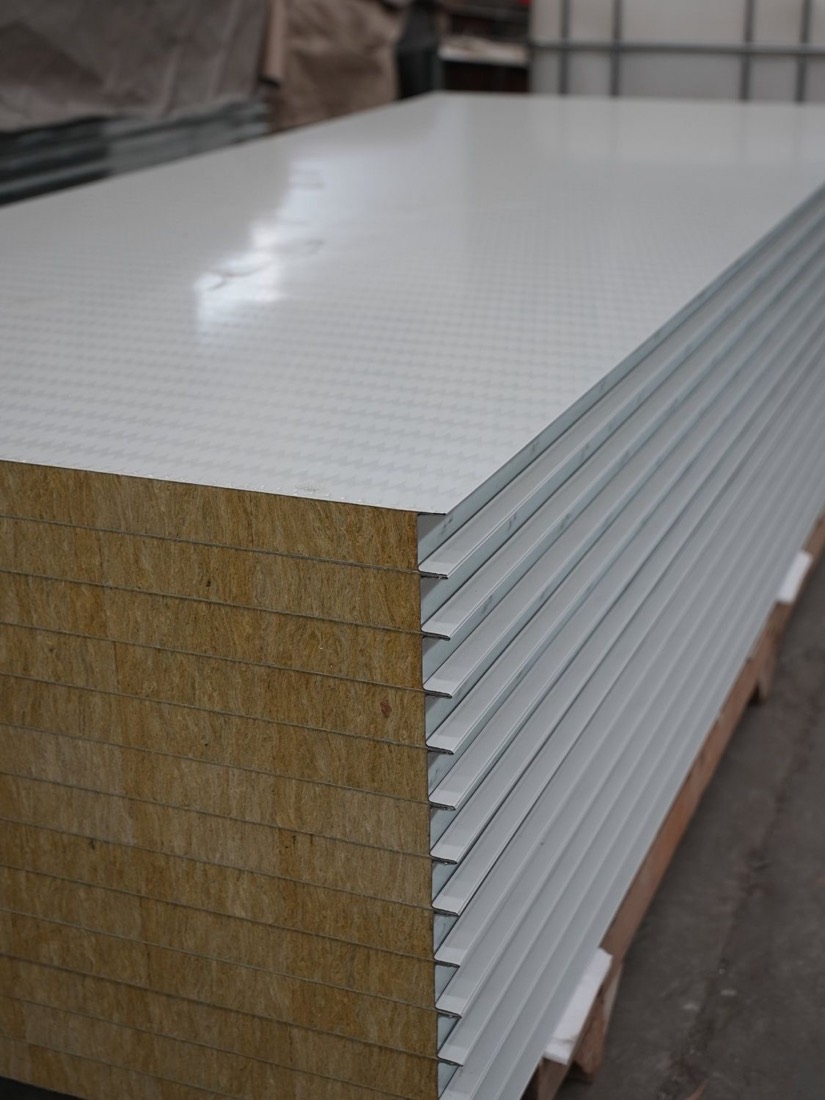
Rock Wool Sandwich Panels for Cleanrooms
Rock wool panels have a non-combustible mineral wool core between two metal faces. Buyers use them for cleanroom walls and ceilings, partition walls between areas, and factory or warehouse walls and roofs. We make them in our own factory in Binhai New Area, Tianjin, which has 4 panel production lines, both continuous and handmade, and you can see the lines on a live video tour before you order.
Best for
- Pharmaceutical and food clean areas
- Hospital and laboratory rooms
- Electronics assembly rooms
- Internal partition walls that separate areas
- Factory and warehouse walls and roofs
Video
Made in our factory
Specifications
Typical specification
| Core | Rock wool (non-combustible mineral wool) |
|---|---|
| Faces | Colour-coated steel; stainless steel on handmade panels. Thickness, coating and colour to order |
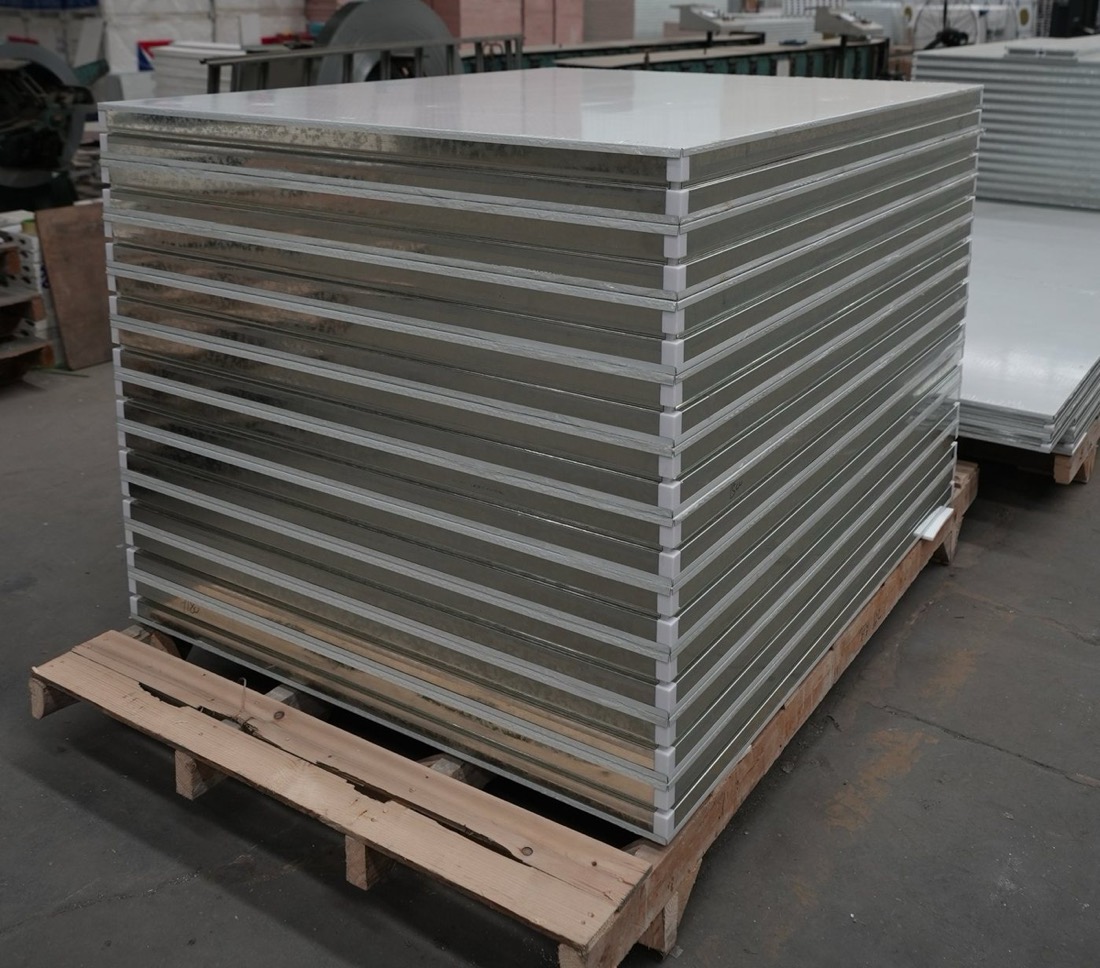
| Edge frame (handmade) | Galvanized steel frame strips and corner fittings on all four edges |
| How it is made (handmade) | Faces, edge frame and core are bonded by heating, pressing and curing |
| Handmade panel width | 1,180 mm standard |
| Handmade panel thickness | 50 mm standard |
| Handmade panel length | 100–6,000 mm cut length |
| Tongue-and-groove width series | 950 mm and 1,150 mm (effective cover width is confirmed on the section drawing) |
| Tongue-and-groove thicknesses | 40, 50, 75, 100, 150, 200 and 250 mm |
| Tongue-and-groove model codes | HA-RW-TG950/40 to /250 and HA-RW-TG1150/40 to /250 |
| Joints | Handmade: centre aluminium connection or male-female. Wall and roof series: tongue-and-groove |
Options
What you can specify
- Colour-coated or stainless steel faces
- PE polyester, HDP polyester or PVDF coating
- Anti-static or conductive face finish
- Centre aluminium or male-female joint on handmade panels
- Tongue-and-groove wall and roof panels
- Cut lengths to your panel schedule
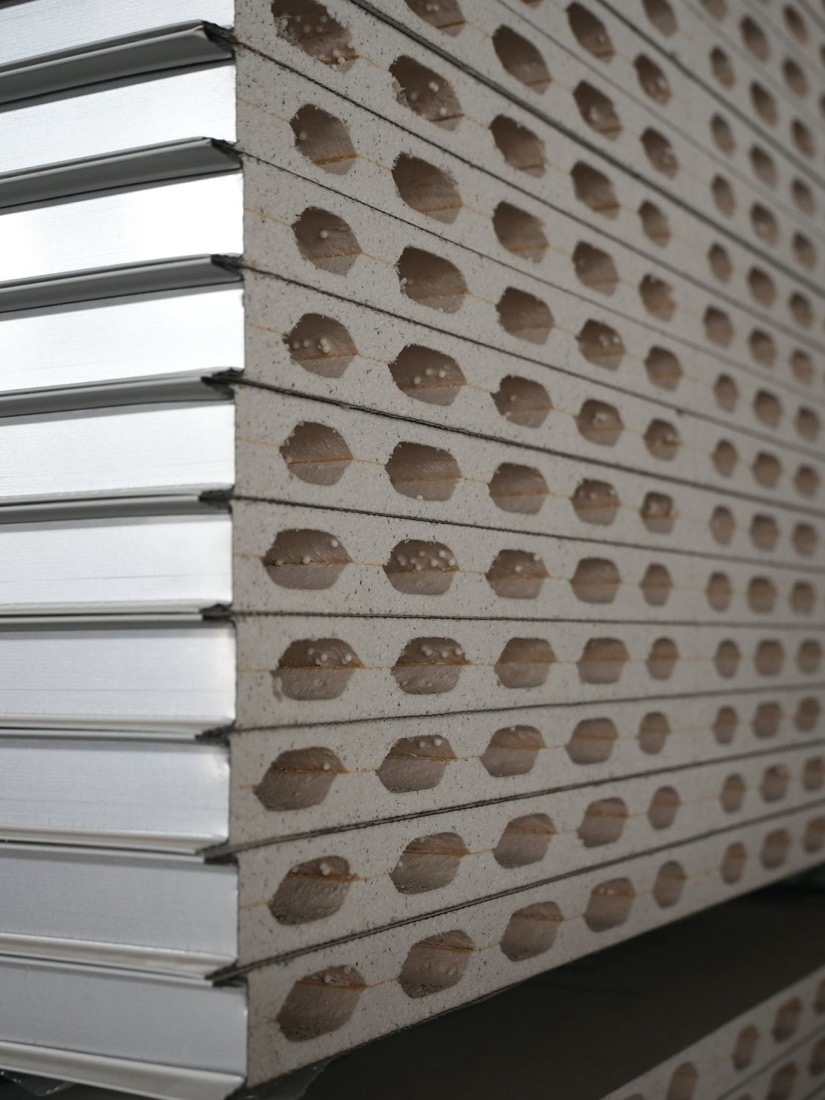
- Rock wool core with one or both faces backed by an MgO board layer (confirm the layer build-up on the drawing)
- Matching aluminium profiles: channels, H-connectors, corner posts, inner and outer curved coving, door and window sections
How to choose a rock wool panel
Rock wool is a non-combustible mineral core. It is used where a combustible foam core is not allowed, such as fire-separating walls. PU or PIR panels are lighter and are usually chosen for insulation, for example in cold rooms.
Handmade or tongue-and-groove: which family you need
We make rock wool panels in two families. They have different sizes and joints, so treat them as two products on a quotation.
| Handmade cleanroom panel | Tongue-and-groove panel | |
|---|---|---|
| Typical use | Cleanroom walls and ceilings | Factory and warehouse walls and roofs, partitions |
| Width | 1,180 mm standard | 950 or 1,150 mm series |
| Thickness | 50 mm standard | 40, 50, 75, 100, 150, 200, 250 mm |
| Length | 100–6,000 mm cut length | Set by your panel schedule |
| Joint | Centre aluminium connection or male-female | Tongue-and-groove |
| Edges | Galvanized steel frame strips and corner fittings | Confirmed on the quotation |
| Faces | Colour-coated or stainless steel | Colour-coated steel |
The handmade family is our cleanroom panel: it takes stainless faces and a centre aluminium or male-female joint. The tongue-and-groove family is our wall and roof series, for the building around the cleanroom and for partitions.
Do not use the 1,180 mm width to count tongue-and-groove panels, or the 950/1,150 mm series to count handmade panels. Mixing them gives the wrong panel count.
Rock wool against the other cores we make
| Core | Fire note | Weight | Insulation | Use it when |
|---|---|---|---|---|
| Rock wool | Non-combustible mineral core | Heaviest of the mineral cores | Better than hollow MgO | A combustible core is not allowed and insulation matters |
| Hollow MgO | Non-combustible inorganic core | Medium | Moderate | You want a lighter non-combustible panel in a dry room |
| PU | Organic foam; class depends on formulation and test | Light | Used for insulation-led rooms | Insulation is the main need and fire rules allow foam |
| Honeycomb (aluminium or paper) | Depends on the core | Light | Confirmed on the quotation | Light partitions and ceilings with a support design |
Fire rules set the shortlist. A core name does not give a fire rating. The rating belongs to the tested panel, so ask for the report that covers the faces, core and thickness on your quotation. For the Euroclass system, see our panel selection guide.
What to specify in an enquiry
Send the destination country, whether the panels are for walls or ceilings, and the drawing revision. Give the thickness, effective cover width, cut lengths and the quantity at each length. State both metal faces: material, coating, thickness and colour. Add the joint type, the openings for doors, windows and pass boxes, and any test or design documents you need. For a roof, send the roof section, supports, penetrations and edge details.
Quote checklist
| Send | Why |
|---|---|
| Destination country and port | Packing, freight and any local product rules |
| Wall and ceiling schedules, sent separately | Ceilings need a support design; walls do not use the same quantities |
| Family, thickness and width series | Handmade 1,180 mm and tongue-and-groove 950/1,150 mm are counted differently |
| Cut lengths and quantity at each length | Panels are cut and numbered to your layout |
| Both faces: metal, coating, thickness, colour | Each side can differ; corridor and room sides are often different |
| Joint type | Centre aluminium or male-female for handmade panels |
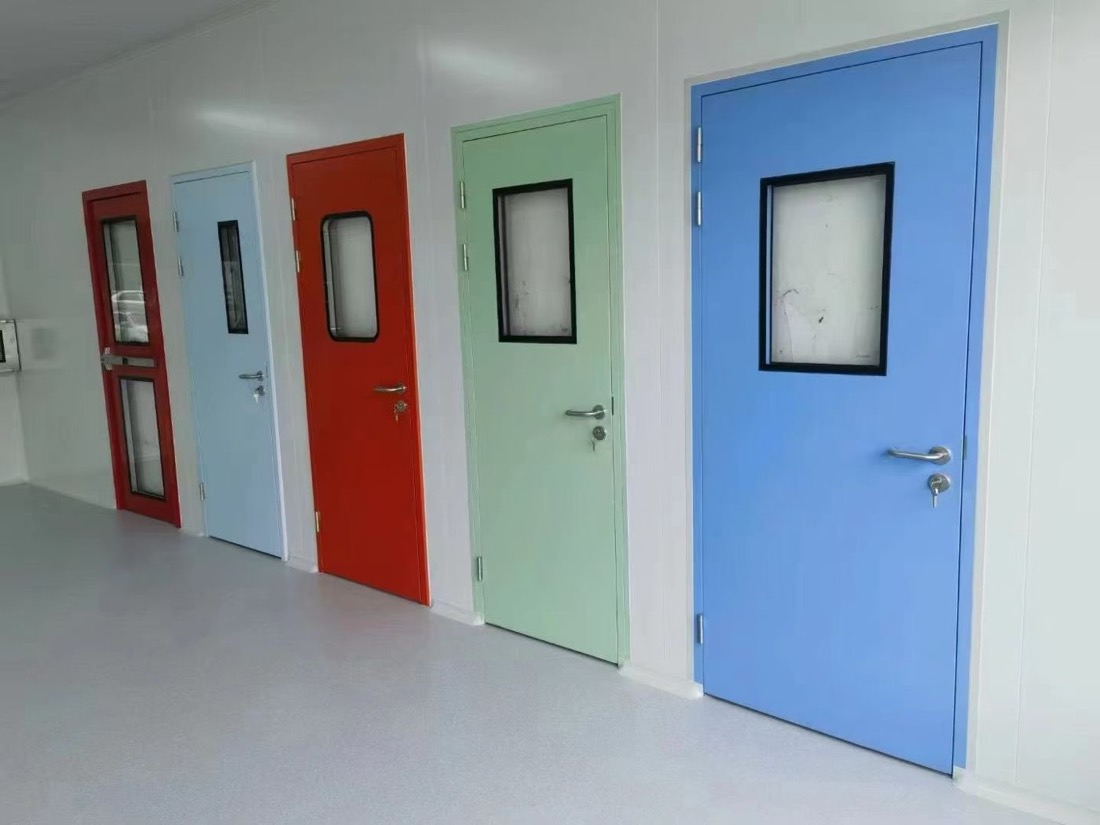
| Openings for doors, windows, pass boxes | Openings and frames are planned with the panels |
| Cleaning agents used in the room | Coating and sealant must tolerate them |
| Reports you need (fire, thermal) | Reports must match the exact build |
If you only have a floor plan, that is enough to start. Our room list builder takes about five minutes.
Installation and what ships with the order
On supply-only orders your local crew installs the panels. Each order can ship with:
- a layout drawing with every panel numbered, and door, window and corner positions marked;
- panels cut to length and labelled to match the drawing;
- an installation guide in English, Spanish, Portuguese, Arabic or Russian, with short videos of each step;
- an accessory kit: floor tracks, aluminium profiles, corner coves, flashings, screws and sealant;
- a WhatsApp video call with our engineer to check set-out and the first panels.
On-site supervision can be arranged for larger projects; the scope is set in the quotation. The usual sequence is floor track, wall panels, corners, ceiling, doors and windows, then lights, filters and penetrations, then the final seal and a leak test. See the panel installation guide for tolerances and sealing rules.
Panels leave the factory strapped and stacked on timber pallets.
What goes wrong on site
A width series is not an effective cover width. If the two are mixed up on a quotation, the panel count is wrong. Ask for the dimensioned section drawing before you calculate quantities.
A core name does not give a fire rating. The rating belongs to the tested panel assembly, so ask for the report that matches the build you are quoted. Panel thickness alone does not set a ceiling load or a walk-on rating.
Customs code
A US customs ruling (N358876, March 2026) classed a steel-faced cleanroom partition panel with a rock wool core under subheading 7308.90. Goods sold as a complete prefabricated building may fall under heading 9406 instead. Customs in your country decides, so ask your broker to confirm the code for your panel.
Cleanroom panel selection: core materials compared
Questions
Common questions
Which widths and thicknesses are listed?
Handmade panels are 1,180 mm wide and 50 mm thick as standard, cut from 100 to 6,000 mm. Tongue-and-groove panels are listed in 950 and 1,150 mm series at 40, 50, 75, 100, 150, 200 and 250 mm. The size you are offered is confirmed on the section drawing in the quotation.
Does a rock wool core give a fire rating?
No. Fire performance belongs to the tested panel assembly and standard. Ask for the report that covers the exact faces, core and thickness you are quoted.
Can a team that has never installed panels use these?
Panels are numbered and sent with layout drawings and an installation guide. Our engineers give video-call support to your team.
Should I use the handmade or the tongue-and-groove rock wool panel for a cleanroom?
The handmade family is our cleanroom panel: 1,180 mm wide, 50 mm thick, with a centre aluminium or male-female joint and colour-coated or stainless faces. The tongue-and-groove family is mainly for building walls, roofs and partitions.
Can I see the panels being made before I order?
Yes. We run live video tours of our panel lines in Tianjin, and you can also audit the factory in person. See our factory audit guide for what to check.
Project enquiry
Send what you have
A room list, a floor plan or only the floor area is enough to start. After you submit, send drawings by email or WhatsApp.
We reply by email within one working day. We can sign an NDA before you send drawings.
WhatsApp +44 7962 561184 is our UK number for export enquiries. The factory is in Tianjin, China.
Email: [email protected]
WhatsApp: +44 7962 561184