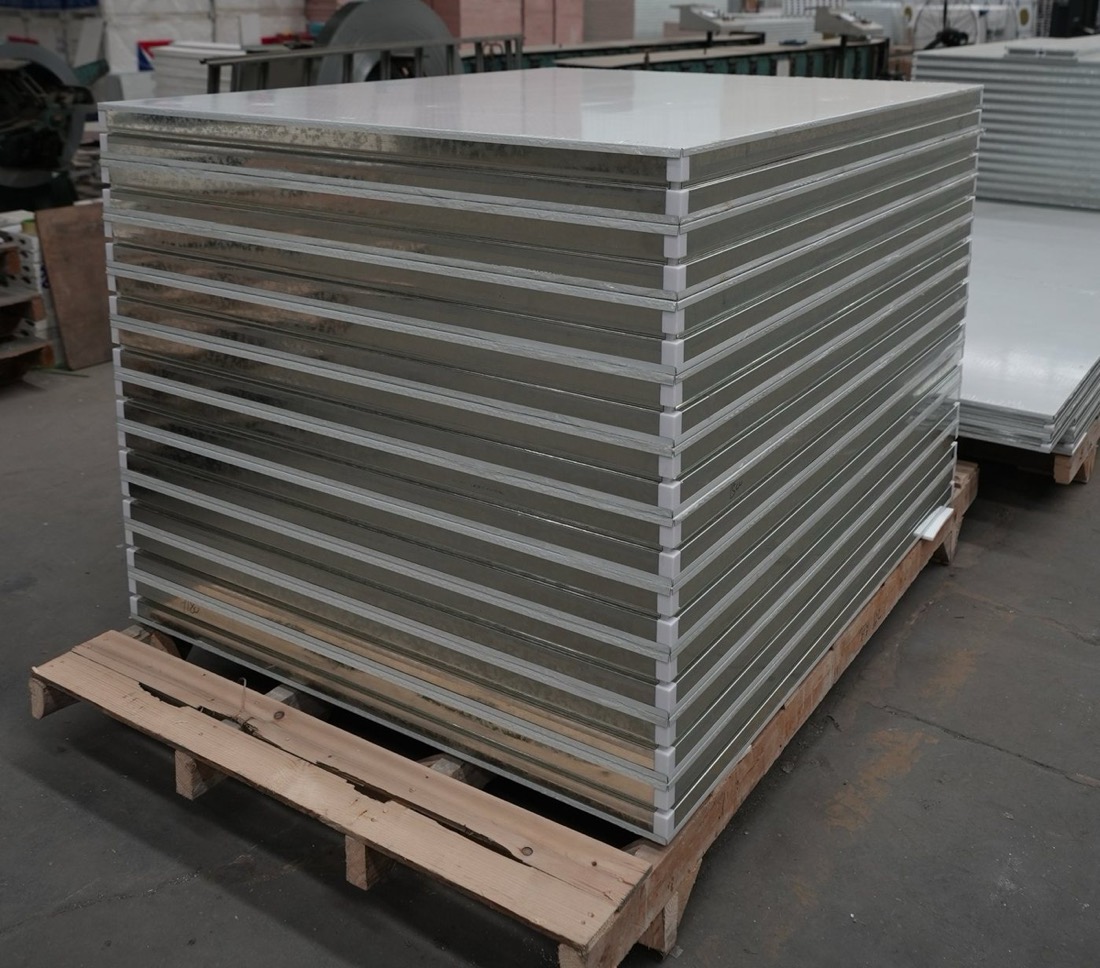
PU Sandwich Panels for Cleanrooms and Insulated Rooms
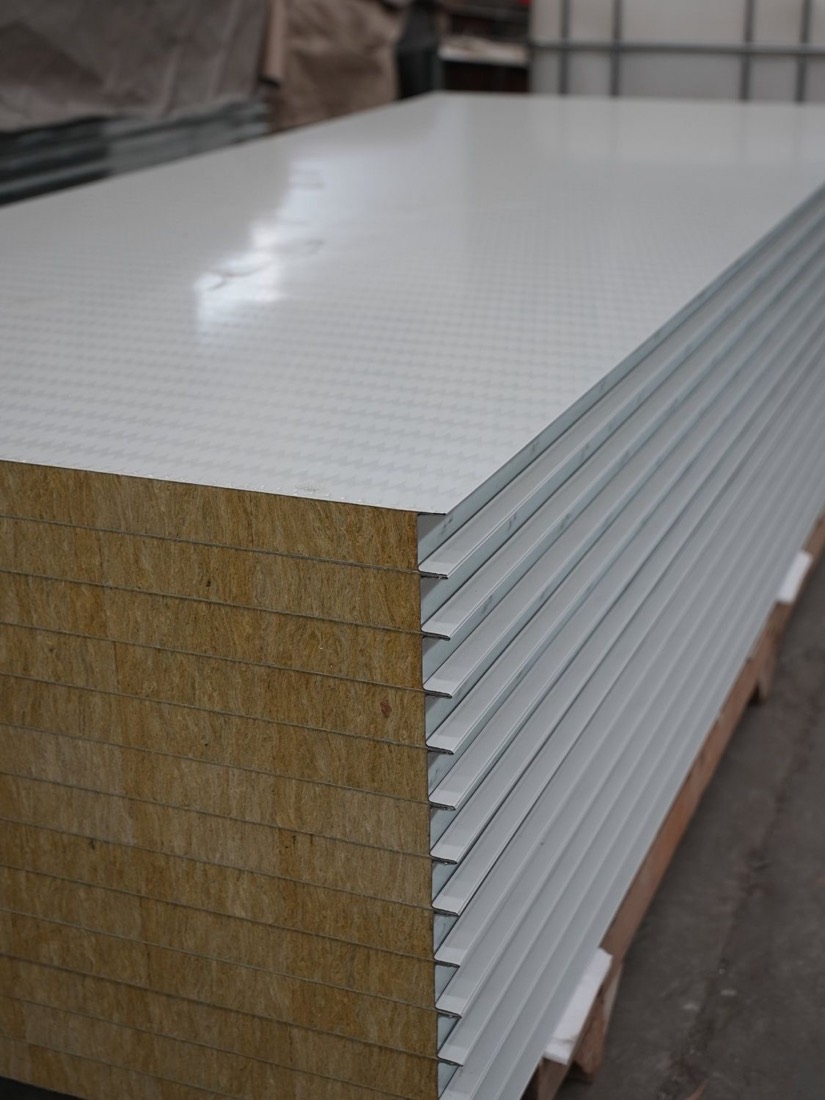
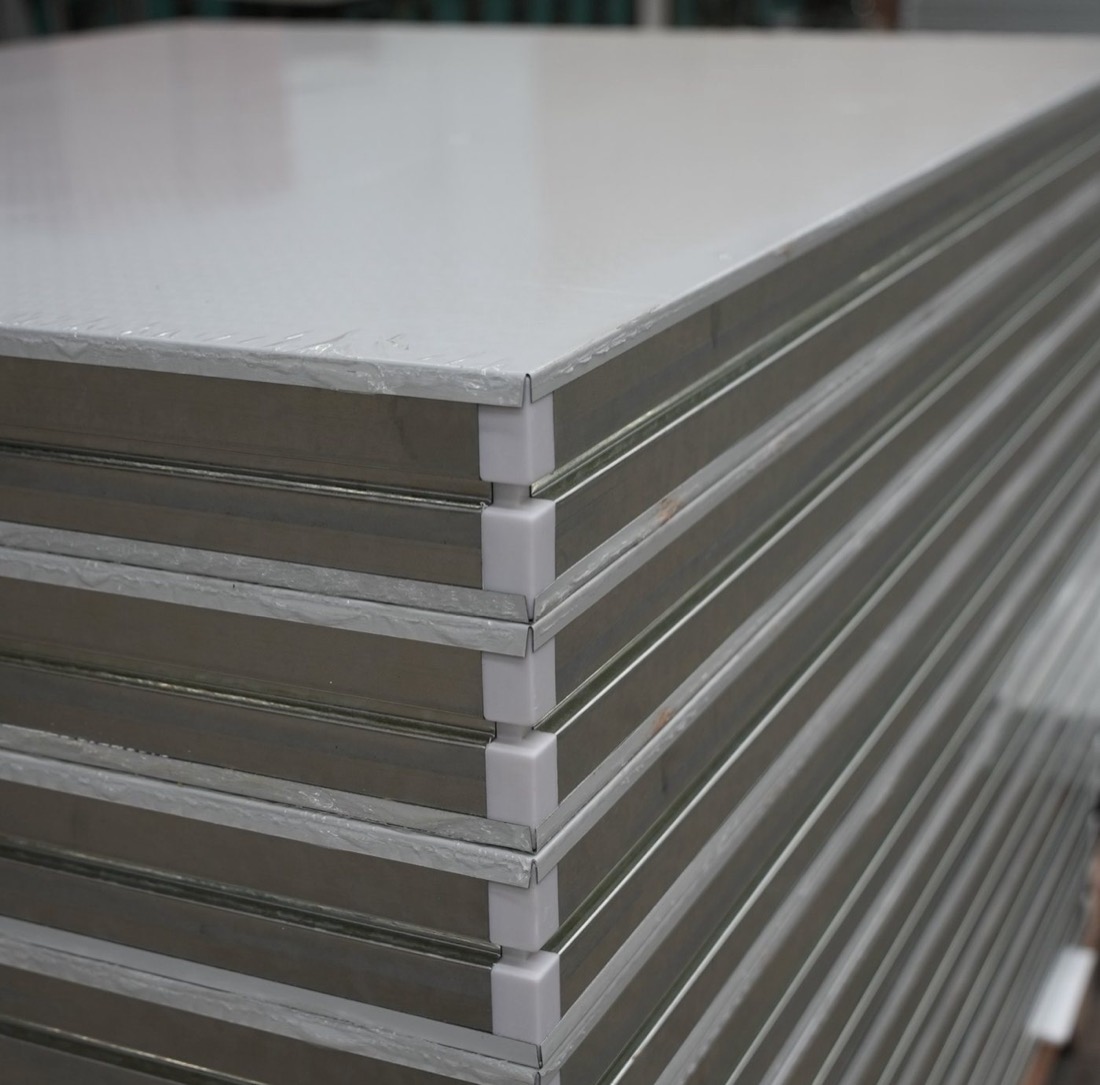
PU panels are tongue-and-groove sandwich panels with a polyurethane foam core between metal faces. Buyers use them for partitions, cleanroom walls and ceilings, and insulated enclosures. They are made in our own factory in Binhai New Area, Tianjin, on the same site as our rock wool and handmade cleanroom panels.
Best for
- Partition walls
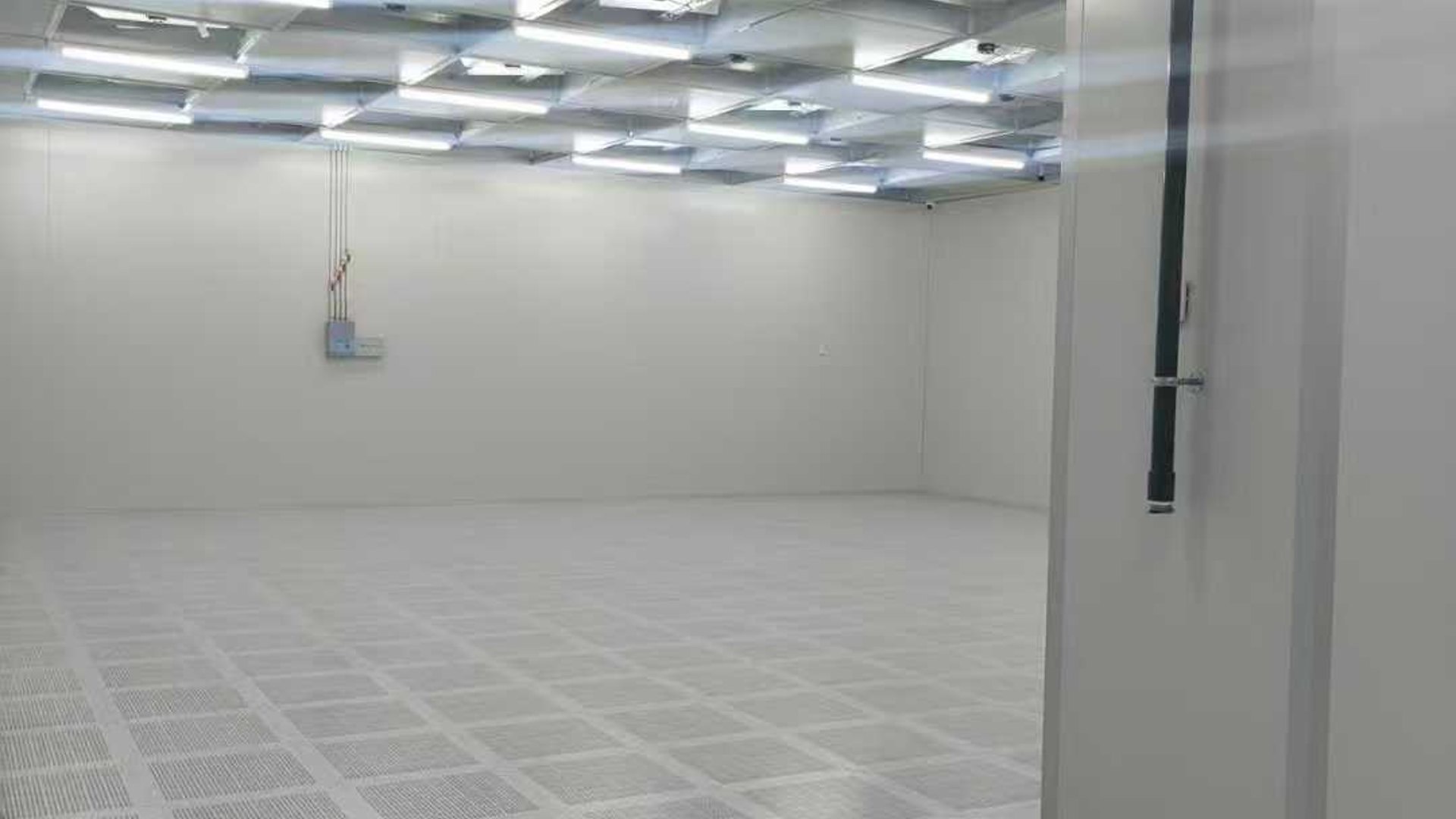
- Cleanroom walls and ceilings
- Insulated enclosures
- Temperature-controlled rooms
Specifications
Typical specification
| Core | Polyurethane (PU) foam |
|---|---|
| Width series | 950 mm or 1,150 mm (effective cover width is confirmed in the quotation) |
| Listed thicknesses | 40, 50, 75, 100, 150, 200 and 250 mm |
| Metal faces | Colour-coated, galvanized or embossed steel |
| Joint | Male-female tongue-and-groove |
| Length | Set by your panel schedule; manufacturing and transport limits are confirmed in the quotation |
| PIR and phenolic | Availability confirmed on request. PU sizes do not apply to them |
| Thermal and fire documents | Requested per model and tested assembly |
| Model codes | HA-PU-TG950/40 to /250 and HA-PU-TG1150/40 to /250 (14 codes, see table below) |
Options
What you can specify
- 950 or 1,150 mm width series
- Seven listed thicknesses from 40 to 250 mm
- Colour-coated, galvanized or embossed steel faces
- PIR or phenolic core, availability confirmed on request
- Cut lengths to your panel schedule
How to choose a PU panel
PU panels are lighter than rock wool and are usually chosen for insulation, for example in cold rooms. Where a non-combustible core is required, compare rock wool panels in the same width series.
PU, PIR and phenolic are different cores. State which one you need, and whether phenolic refers to the core or to the facing. Thermal and fire performance belong to the tested assembly, so ask for model-specific documents.
Model codes
The catalogue lists one code per width and thickness. Put the code on your enquiry and ask for the section drawing.
| Thickness | 950 mm series | 1,150 mm series |
|---|---|---|
| 40 mm | HA-PU-TG950/40 | HA-PU-TG1150/40 |
| 50 mm | HA-PU-TG950/50 | HA-PU-TG1150/50 |
| 75 mm | HA-PU-TG950/75 | HA-PU-TG1150/75 |
| 100 mm | HA-PU-TG950/100 | HA-PU-TG1150/100 |
| 150 mm | HA-PU-TG950/150 | HA-PU-TG1150/150 |
| 200 mm | HA-PU-TG950/200 | HA-PU-TG1150/200 |
| 250 mm | HA-PU-TG950/250 | HA-PU-TG1150/250 |
A width series name is not the effective cover width. Confirm the cover width on the section drawing before you count panels.
Which thickness?
No cleanroom standard fixes a panel thickness. Thickness follows the job the wall has to do:
- Insulation. A room held well below or above the temperature of the space around it needs more insulation. Ask for the declared thermal value for the exact thickness, and compare suppliers on the same basis. Our thermal value comparison sheet shows how.
- Span. Taller walls and longer ceiling spans need a stiffer panel. Ask for an assembly-specific span or load check; thickness alone does not set a ceiling load.
- Frames and openings. Our door frames and observation windows are listed for 50, 75 and 100 mm walls. If you choose another thickness, ask how doors and windows will be fitted.
PU or rock wool?
| PU panel | Rock wool panel | |
|---|---|---|
| Core | Organic foam | Non-combustible mineral wool |
| Weight | Lighter | Heavier |
| Usually chosen for | Insulation, cold rooms, insulated enclosures | Fire-separating walls, rooms where a foam core is not allowed |
| Widths | 950 or 1,150 mm series | 950 or 1,150 mm series; handmade 1,180 mm |
| Thicknesses | 40–250 mm | 40–250 mm (tongue-and-groove); 50 mm standard handmade |
| Fire class | Depends on formulation; ask for the report | Ask for the report on the exact build |
If your fire rules or insurer do not allow a foam core, start from rock wool panels. For a full comparison, see the panel selection guide.
What to specify in an enquiry
Send the destination country and a panel schedule with cut lengths. Give the required core, both metal faces, the effective cover width and the joint details. For cleanroom use, add the face finish, joint sealing, the cleaning agents used and your acceptance requirements. List trims, sealants, packing and any installation work you want in the scope.
Quote checklist
| Send | Why |
|---|---|
| Model code or width series and thickness | One code per width and thickness |
| Panel schedule with cut lengths and quantities | Panels are cut and numbered to the layout |
| Room temperatures, inside and outside | To check the thickness against the insulation you need |
| Both faces: steel type, coating, colour | Colour-coated, galvanized or embossed |
| Core: PU, PIR or phenolic | Different cores; test data does not carry over |
| Trims, sealants, floor and ceiling details | Listed in the scope so quotations compare line by line |
| Reports you need | Fire or thermal reports, for the exact build |
| Destination country and port | Packing and freight |
Installation and what ships with the order
Each order can ship with numbered panels cut to length, a layout drawing, an installation guide in English, Spanish, Portuguese, Arabic or Russian, an accessory kit (floor tracks, aluminium profiles, corner coves, flashings, screws and sealant) and a WhatsApp video call with our engineer for set-out and the first panels. Panels are packed strapped and stacked on timber pallets. See installation support.
What goes wrong on site
A width series is not an effective cover width, so confirm it before you calculate quantities. Ceiling loads and accessories need a separate assessment. A panel does not set a room's ISO class by itself.
Test results for one core do not carry over to another. Do not apply PU data to a PIR or phenolic panel.
Cleanroom panel selection: core materials compared
Questions
Common questions
Which widths and thicknesses are PU panels listed in?
950 or 1,150 mm widths, and thicknesses of 40, 50, 75, 100, 150, 200 or 250 mm. Confirm the profile, effective cover width, length and delivery dimensions in the quotation.
Is a phenolic panel the same as a PU panel?
No. State whether phenolic refers to the core or the facing. Do not apply PU sizes or test results to a phenolic or PIR configuration. Ask us to confirm current availability and the offered construction.
Can PU panels be used for cleanroom walls and ceilings?
Yes, for partitions, ceilings and insulated enclosures. Confirm the face finish, joint sealing, cleaning compatibility and acceptance requirements. Ceiling loads and accessories need a separate assessment.
What thickness of PU panel do I need for a cleanroom?
No cleanroom standard sets one. Thickness follows the insulation you need, the wall height or ceiling span, and the door and window frames, which we list for 50, 75 and 100 mm walls. Send the room temperatures and heights and we will propose a thickness with the section drawing.
Is a PU panel allowed in a fire zone?
That depends on your local fire rules and insurer, and on the fire report for the exact panel. PU is an organic foam, and its class depends on formulation. Where a non-combustible core is required, use rock wool or hollow MgO panels.
Project enquiry
Send what you have
A room list, a floor plan or only the floor area is enough to start. After you submit, send drawings by email or WhatsApp.
We reply by email within one working day. We can sign an NDA before you send drawings.
WhatsApp +44 7962 561184 is our UK number for export enquiries. The factory is in Tianjin, China.
Email: [email protected]
WhatsApp: +44 7962 561184