Buyer guide
Cleanroom panel selection: core materials compared
Choose a cleanroom panel core by the fire test report of the finished panel first, then by moisture exposure, weight and joint flatness. EPS is combustible, rock wool, silica rock and MgO cores are mineral or inorganic, and PU and honeycomb vary with formulation or core material, so each needs a report for the exact panel.
By ZY Cleanroom · Updated · Sources at the end of the page
Fire class comes from the panel test
EU Regulation 2016/364 sets the classes below. Smoke (s1 to s3) and flaming droplet (d0 to d2) ratings add to classes A2 to D. A class belongs to the product as tested, so ask for the report on the finished panel at your thickness, not the core alone.
| Euroclass | Key limit | Test method |
|---|---|---|
| A1 | Temperature rise 30 °C or less, mass loss 50% or less, no sustained flaming | EN ISO 1182, EN ISO 1716 |
| B | FIGRA 120 W/s or less | EN 13823, EN ISO 11925-2 |
| C | FIGRA 250 W/s or less | EN 13823, EN ISO 11925-2 |
| D | FIGRA 750 W/s or less | EN 13823, EN ISO 11925-2 |
| E | Flame spread 150 mm or less within 20 s, after 15 s of flame | EN ISO 11925-2 |
| F | Fails class E | Not applicable |
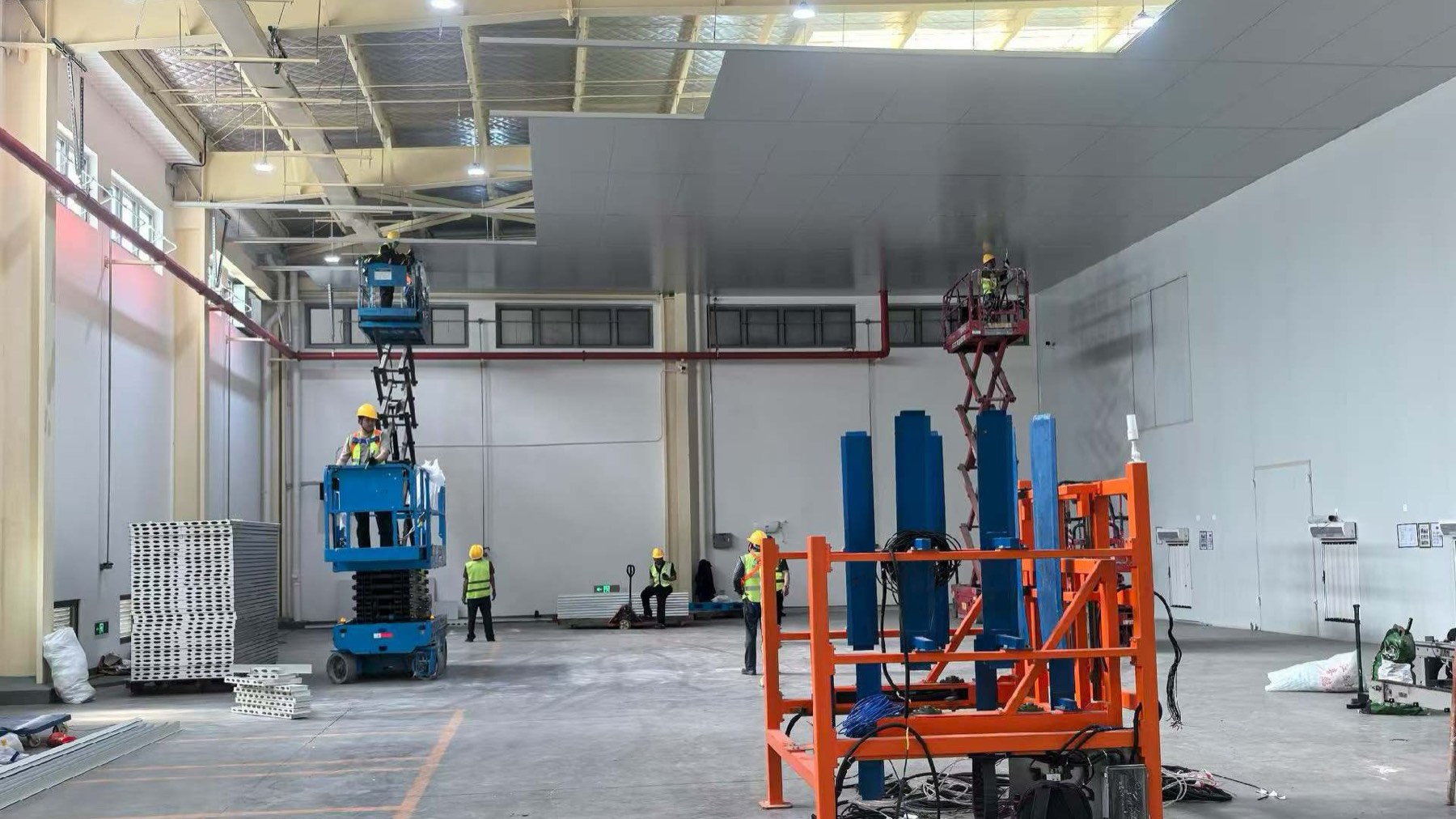
Core comparison
Weight ranks come from the panel maker's own core comparison (23 October 2026). Fire notes come from the sources listed.
| Core | Fire note | Weight | Typical use | Ask for |
|---|---|---|---|---|
| EPS | Combustible. With flame retardant it can reach Euroclass E. | Light | Dry partitions, warehouses | Fire report; check fire rules allow it |
| PU / PIR | Organic foam. Class depends on formulation. | Light | Insulation-led walls, cold rooms | Class report for the panel |
| Rock wool | Mineral fibre core. | Heavier | Fire-rated walls and ceilings | Class report; core density |
| Silica rock | Inorganic board core. | Medium | Flat, stiff walls and ceilings | Class report for the panel |
| Hollow MgO | Inorganic board core. Chloride-type boards can corrode metal when damp. | Medium | Walls and ceilings in dry areas | Board chemistry; moisture limit |
| Honeycomb | Depends on the core: paper or aluminium. | Light | Light partitions, door leaves | Core named in the report |
Moisture and joints
CCMC's 2018 advisory covered magnesium oxychloride boards. It linked chloride and moisture to corrosion of metal and advised caution in humid conditions. It had not evaluated oxysulfate or oxyphosphate boards.
Rock wool with polyurethane-filled edges keeps the rock wool core and closes joints tighter, according to the panel maker's own data.
Insulation and conformity route
For insulation, the BPF EPS Group gives typical thermal conductivity from 0.038 W/m·K for EPS 70 to 0.034 for EPS 200 and 250, at 10 °C. Ask every supplier for the declared value for its own core on the same basis.
For PUR or PIR cores of class C or better, Efectis says production surveillance by a notified body (system 1) applies if the manufacturer adds fire retardants. System 3 applies with a written supplier declaration that none are present.
Joint type changes leakage and cleaning. Panel makers list tongue-and-groove, centre aluminium and male-female joints.
Weight arithmetic
Two 0.5 mm steel facings weigh about 7.9 kg/m² whichever core you pick (steel at 7,850 kg/m³ × 0.0005 m × 2). Compare suppliers on declared mass in kg/m² at the same thickness and facing.
What to ask each supplier
Ask for the fire classification report with laboratory name, date and tested thickness. Ask for the type-test list: Efectis names thermal, acoustic, mechanical, fire, water and air tightness, dimensional and durability characteristics for sandwich panels under their harmonised standard. Ask for factory production control records, the joint drawing, and the facing steel grade and thickness.
A regulator or insurer approves the owner's facility, not the contractor. To have a room list reviewed, send it to ZY Cleanroom, a cleanroom design-and-build contractor with its own panel factory in Tianjin, China.
Paper honeycomb wall panel core: what to check before you choose it
A paper honeycomb core is a layer of hexagonal paper cells bonded between two facings. The core comparison above lists honeycomb as light and says its fire note depends on the core, so the paper version needs its own checks.
A review inside a 2020 paper on paper cell cores (Materials, Basel, 13(9):2058) reports that compressive strength in humid conditions can be as low as 25% of the dry value. That paper tested cores in compression, not wall panels, so it shows the sensitivity of paper, not a rating for any panel.
A 2010 paper in the Journal of the Korean Institute of Fire Science and Engineering says honeycomb paper, widely used as fire-door interior and packing material, needs fire-proofing because it is vulnerable to fire. Of four treatments compared by cone calorimeter, impregnation with flame retardant performed best. A flame-resistant film delayed ignition but worsened heat and smoke release. These were laboratory samples, so only a test of the finished panel decides its class.
| Ask the supplier | Why |
|---|---|
| What paper is the core, and is it impregnated? | In the 2020 test, each of three impregnating solutions (acetylated starch, sodium silicate, epoxy) improved the stiffness of the paper core. |
| What humidity range is the core rated for? | Compressive strength of paper cores can fall to 25% of the dry value in humid conditions (Materials, 2020 review). |
| How is the core fire-treated? | Impregnation gave the best cone calorimeter result of four methods; a surface film did not (Korean Institute of Fire Science and Engineering, 2010). |
| Which fire report covers the finished panel? | A class belongs to the panel as tested (Regulation 2016/364, above), so the report should name the paper core. |
| How are cut edges and openings closed? | EU GMP Annex 1 para 4.7 (25 August 2022) asks for room materials that permit repeated cleaning, disinfectant and sporicidal agents, so seal every cut edge against the liquid. |
Questions
Common questions
Which cleanroom panel core is best?
None suits every room. Fire rules set the shortlist. Wet cleaning, weight and joint flatness then decide.
Is EPS allowed in a cleanroom?
Only where your fire rules allow a combustible core. EPS with flame retardant can reach Euroclass E, the lowest passing class.
Is MgO panel suitable for wet cleaning?
Ask for the board chemistry and moisture limit. CCMC's 2018 advisory advised caution for MgO boards in humid conditions.
Does the core's fire class equal the panel's class?
No. Classes apply to the product as tested, so request the report for the finished panel.
What is the HS code for clean room panels?
US customs ruling N358876 of March 2026 placed a steel-faced cleanroom partition panel with a rock wool core under subheading 7308.90. Goods sold as a complete prefabricated building may fall under heading 9406 instead. Customs in each country decides, so ask your importer or broker to confirm the code for your panel.
What thickness should a cleanroom panel be?
We found no cleanroom standard that fixes a thickness. It follows the fire class you need, the span between supports and the insulation target. A fire report only holds at the thickness tested, so compare suppliers at the same thickness and facing.
Related guides
- Hinged Cleanroom Doors in Brick, Block and Panel Partition Walls
- How to audit a cleanroom panel factory, on site or by video
- Cleanroom airlock design: bubble, cascade and sink
- Cleanroom flooring options: epoxy, vinyl, raised and static control
- Turnkey cleanroom contractor
- Room list builder
Sources
- Commission Delegated Regulation (EU) 2016/364 on the classification of reaction to fire performance of construction products, Annex Table 1 (OJ L 68, 15 March 2016; checked 31 October 2026)
- BPF Expanded Polystyrene (EPS) Group, Fire properties of EPS (undated web page; checked 31 October 2026)
- BPF Expanded Polystyrene (EPS) Group, Properties of EPS, typical thermal conductivity at 10 °C (undated web page; checked 31 October 2026)
- CCMC, MgO Board Advisory Update (1 March 2018), as hosted by the Saskatchewan Building Officials Association (checked 31 October 2026)
- Efectis, CE certification process of sandwich panels (undated web page; checked 31 October 2026)
- Eurocode Applied, Steel design properties, density of steel about 7,850 kg/m3 after EN 1993-1-1 (undated web page; checked 31 October 2026)
- Core comparison table on the silica rock cleanroom panel page, the publisher's own factory data (23 October 2026)
Project enquiry
Send what you have
A room list, a floor plan or only the floor area is enough to start. After you submit, send drawings by email or WhatsApp.
We reply by email within one working day. We can sign an NDA before you send drawings.
WhatsApp +44 7962 561184 is our UK number for export enquiries. The factory is in Tianjin, China.
Email: [email protected]
WhatsApp: +44 7962 561184