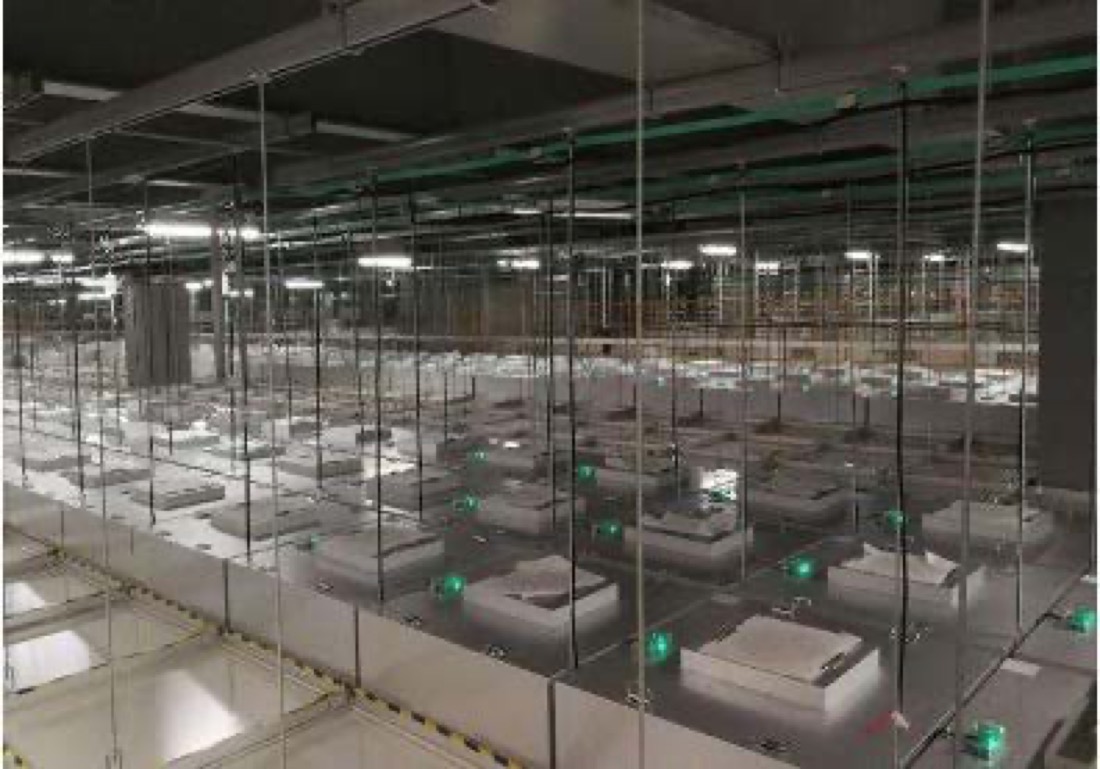
FFUs and HEPA Filters for Cleanrooms
An FFU combines a fan and a filter in one ceiling-mounted unit. This page also covers HEPA terminal housings and cleanroom filters, from pre-filters to HEPA and ULPA. Buyers are cleanroom designers, HVAC contractors and maintenance teams. FFUs and filters are part of our cleanroom product range. We supply them with the panels and ceiling grid in one quotation, so opening sizes match, and each unit is inspected before shipping.
Best for
- Cleanroom ceilings fitted with FFU grids
- Rooms served by ducted HEPA terminal housings
- Filter replacement in existing HVAC systems, FFUs and housings
- Local airflow equipment such as movable laminar-flow carts
Specifications
Typical specification
| FFU | Fan and filter in one unit, mounted in the ceiling grid |
|---|---|
| Ducted HEPA terminal housing | No fan; takes air from the air-handling system through a duct |
| Other air equipment | Movable laminar-flow carts, pneumatic isolation dampers, bag-in/bag-out housings |
| Filter families | Panel pre-filters; bag and W-type medium-efficiency; mini-pleat, separator, gasket-seal, gel-seal and high-temperature HEPA; mini-pleat ULPA |
| HEPA H13 | 99.95% minimum integral efficiency at MPPS (EN 1822 class reference, not a ZY test result) |
| HEPA H14 | 99.995% minimum integral efficiency at MPPS (EN 1822 class reference, not a ZY test result) |
| FFU quote inputs | Dimensions and mounting, airflow at the stated resistance, filter class, voltage and frequency, control interface |
| Filter quote inputs | Type, outer dimensions and depth, rated airflow, initial and final pressure drop, class and standard, seal type, housing drawing, operating temperature |
| Standards named | EN 1822 (H13, H14); ISO 29463-1:2024 (high-efficiency filters); ISO 16890-1 (general-ventilation filters) |
Options
What you can specify
- FFU or ducted HEPA terminal housing
- Gasket-seal or gel-seal HEPA filter
- H13 or H14 HEPA, or ULPA
- High-temperature HEPA filter
- Panel pre-filter, bag or W-type filter
- FFU motor control mode, confirmed for the offered model
How to choose
Decide where the air is made. An FFU has its own fan. A ducted terminal housing has none, so the upstream fan, duct and available pressure must be set in the project design. H14 has a higher minimum efficiency than H13 at the most penetrating particle size (MPPS). MERV 13 and H13 are different classifications and are not interchangeable.
A filter grade or an FFU does not give a room its ISO class. The room design, HVAC system, installation and testing do.
HEPA filter ratings: H13, H14 and the EN 1822 classes
An H13 HEPA filter captures at least 99.95% of particles at the most penetrating particle size, and H14 at least 99.995%. The room specification sets the class you need, not the filter's name.
| EN 1822 class | Overall efficiency, at least | Local efficiency, at least | Nearest ISO 29463 class |
|---|---|---|---|
| E11 | 95% | None set | ISO 15 E |
| E12 | 99.5% | None set | ISO 25 E |
| H13 | 99.95% | 99.75% | ISO 35 H |
| H14 | 99.995% | 99.975% | ISO 45 H |
| U15 | 99.9995% | 99.9975% | ISO 55 U |
Values are at the most penetrating particle size. A US-style figure of 99.97% at 0.3 µm is a different test, so ask which test a quotation uses. Full table: HEPA and ULPA filters guide.
ULPA filters: U15 to U17
A ULPA filter is one of the EN 1822 classes U15 to U17, rated at 99.9995% (U15) to 99.999995% (U17) minimum overall efficiency at the most penetrating particle size. HEPA (H13 and H14) is the step below. For micro-glass media, ISO 29463-1 gives the most penetrating particle size as about 0.12 to 0.25 µm.
We supply mini-pleat ULPA filters, and FFUs fitted with them, where the room specification calls for ULPA. They are changed and leak tested like HEPA filters: no fixed interval, and a leak test after installation and after every change. The price follows the class, size, seal type and quantity, and is confirmed in a written quotation. See HEPA vs ULPA filters.
HEPA filters in pharmaceutical cleanrooms
US drug law (21 CFR 211.42) calls for an air supply filtered through HEPA filters under positive pressure in aseptic processing areas, as quoted in FDA's 2004 aseptic guidance. EU GMP Annex 1 defines a HEPA filter as one specified to a relevant international standard. It asks for an installed filter leak test at qualification (para 4.25), and for a final-filter integrity test at requalification: every 6 months at most in Grades A and B, and every 12 months at most in Grades C and D (para 4.32). Name the standard, edition and class in the URS, and see HEPA filter testing.
HEPA filters for operating theatres: H13 or H14?
For an operating theatre, the filter class comes from the hospital standard your project follows, not from the filter's name. Under EN 1822, an H13 filter captures at least 99.95% of particles at the most penetrating particle size and an H14 filter at least 99.995% (see the table above). Some hospital guidance sets other values: the UK HTM 03-01 gives EPA filters of class E10 to E11 as a typical value for ultra-clean theatre air terminals, and India's NABH asks for HEPA filters of 99.97% at 0.3 micron, which is a different test. State the class and the standard in the room data sheet. See operating room laminar flow ceilings.
For medical use, the HEPA filter class is set room by room by the national hospital guidance, not by the filter maker.
Fan filter unit specifications: what to ask every supplier for
A Lawrence Berkeley National Laboratory test of 20 commercial FFUs (LBNL-55039, 2004) found energy performance differed considerably between units. Its test method measures five things. Use them as the headings of your FFU data sheet:
- Total electric power at your duty point
- Total pressure efficiency
- Airflow rate
- Pressure difference across the unit
- Airflow uniformity across the filter face
Add noise at the duty point with the test distance stated, and the speed control and monitoring interface.
For fan type, noise and control, see fan filter unit selection.
For unidirectional flow, FDA's 2004 aseptic guidance gives 0.45 m/s ±20%, and EU GMP Annex 1 para 4.30 gives 0.36 to 0.54 m/s at the working position as a guidance value. Ask for measured face velocity, not only airflow.
FFU module size and the ceiling grid
FFUs are made to drop into the bays of a ceiling grid. Common nominal modules are 2 × 4 ft, 2 × 2 ft and 3 × 2 ft (about 1,200 × 600, 600 × 600 and 900 × 600 mm). Many units carry a pre-filter ahead of the HEPA or ULPA filter. Choose the module with the ceiling grid, not after it: our cleanroom ceilings and FFUs are quoted together, so the grid bay and the unit size match. See FFU ceiling layout.
Gel seal or gasket seal?
| Gel seal | Gasket seal | |
|---|---|---|
| Housing | Needs a knife-edge housing | Needs a flat sealing face |
| Check on site | Knife edge sits fully in the gel | Gasket position and compression |
| Swap one for the other | Not without changing the housing | Not without changing the housing |
Receiving, storing and installing HEPA filters
Each filter is inspected before shipping. Damage can still happen in transit or on site, so build these steps into the installation plan. They follow the NIH Office of Research Facilities technical bulletin on HEPA air filtration in cleanrooms (July 2022).
| Step | What to do |
|---|---|
| On arrival | Inspect each filter for damage, and again just before installation. Do not touch the media face with hands or tools. |
| Storage | Indoors, protected from damage and water, in the orientation the label shows; the bulletin gives 4.4–37.8 °C and 25–75% relative humidity. |
| Spares | Some filters fail the first leak test on installation. The bulletin suggests keeping at least 20% extra filters on hand to avoid delays. |
| Housing | Clean the housing before fitting the filter. Prefer housings with room-side aerosol challenge and pressure test ports, and room-side filter replacement. |
| Face velocity | Terminal HEPA filters are generally designed for a face velocity of no more than 0.5 m/s. |
| Leak test | Test at the factory and again in place. Individual leaks should not exceed 0.01% of the upstream challenge. See HEPA filter leak test. |
| Repair | Repairs follow an approved patching procedure, with no patching along the filter edge. The bulletin requires replacement where a leak exceeds the 0.01% limit, and allows no field repair of filters in ISO 5 zones. |
For filter classes and where H13, H14 and ULPA filters are used, see HEPA and ULPA filters.
FFU and HEPA filter installation: the leak test
A filter class rates the filter. A leak test proves the installed filter and its seal. ISO 14644-3:2019 clause B.7 sets out the method. EU GMP Annex 1 para 4.25 asks for an installed filter leak test at qualification. Leave test access for each filter. See HEPA leak testing.
HEPA filters and FFUs for sites in Central Asia
HEPA filters and fan filter units are supplied as part of a cleanroom project, in one quotation with the panels, doors and ceiling grid. Each unit is inspected before shipping. The goods are packed in Tianjin and ship in one consignment with the panels; the route and transport to Almaty, Tashkent or another site city are agreed in the quotation. See the Kazakhstan and Uzbekistan pages and the import guide.
To select the filters, send:
- the filter class (H13 or H14) and the standard it is stated to;
- the outer dimensions and depth of the filter, or the cell size of the ceiling grid;
- the seal type (gel or gasket) and, for replacement filters, the housing drawing;
- the site city.
What to specify in an enquiry
For FFUs, send the unit dimensions and mounting, the airflow at the stated resistance, filter class, voltage and frequency, the speed control or monitoring interface, and quantity. State noise test conditions if noise matters. For filters, send the type, outer dimensions and depth, rated airflow, initial and final pressure drop, the standard and class, seal type, housing drawing, operating temperature and the test reports you need.
Quote checklist
| For FFUs | For replacement filters |
|---|---|
| Unit size and ceiling grid module | Outer dimensions and depth |
| Airflow at stated resistance | Rated airflow |
| Filter class (EN 1822 or ISO 29463) | Class, standard and test |
| Voltage, frequency, motor type | Initial and final pressure drop |
| Control mode and monitoring interface | Seal type and housing drawing |
| Noise target with test distance | Operating temperature |
| Quantity and ceiling layout | Photos of the label on the old filter |
What goes wrong on site
Gel-seal filters need a knife-edge housing, and gasket filters need the gasket position and compression checked. Do not swap one for the other without checking the housing. Adding FFUs to an existing room is not a plug-in job: check the ceiling structure, airflow balance, returns, power and controls first.
An EC motor or speed control alone does not mean constant airflow. Specify the control mode and the airflow you need.
Fan filter unit selection: fan type, noise, control and sizing
Questions
Common questions
What is the difference between H13 and H14?
H14 has a higher minimum integral efficiency than H13 at the most penetrating particle size. The EN 1822 class references are 99.95% for H13 and 99.995% for H14. These are class references, not test results for a ZY product.
When is an H13 HEPA filter enough?
When your room specification, or the standard you work to, calls for H13. EN 1822 does not tie a filter class to a room class; the room's final class depends on the airflow, the design and the test after installation. State the class and the standard in the room data sheet, and ask for the filter's factory test certificate.
How often should HEPA filters be replaced in a cleanroom?
The standards we checked set no fixed interval. Change it when it fails the leak test, is damaged or wet, no longer gives the design airflow, or reaches the final resistance stated for it. Record the pressure drop to plan the change, and repeat the integrity test after every change.
What sizes do HEPA filters come in?
The size follows the housing or FFU it fits. For a replacement, send the outer dimensions, depth, seal type, rated airflow and class, or a photo of the label on the current filter.
Which standard classifies HEPA filters?
In Europe and on many international projects, EN 1822 classes filters as E10–E12 (EPA), H13–H14 (HEPA) and U15–U17 (ULPA), by the minimum efficiency at the most penetrating particle size. ISO 29463 uses a different class system; state in the data sheet which standard and class you require.
What is the difference between EPA and HEPA filters?
Under EN 1822, EPA filters are classes E10 to E12 and HEPA filters are H13 and H14. E12 is rated at 99.5% at the most penetrating particle size and H13 at 99.95%. State the class you need, because some hospital guidance accepts EPA classes for theatre air terminals while a pharmaceutical specification usually names H13 or H14.
What is UL 900?
A US standard for air filter units. It covers tests of the smoke generated and the combustibility of the filter, in a clean condition (UL 900, edition 8, published 21 April 2015; scope checked 11 November 2026). It is a fire test, not an efficiency class: it does not replace H13, H14 or a leak test. If your project asks for UL 900, state it in the data sheet and ask for the listing of the offered filter.
Can HEPA filters be cleaned or reused?
No. Treat a cleanroom HEPA filter as a replacement part. Washing or vacuuming can damage the filter medium, and we found no cleanroom standard with a method for it. A filter that has been handled needs a new integrity test.
Are HEPA filters used in operating theatres and isolation rooms?
Yes, but the class comes from the standard your project follows. For example, the UK HTM 03-01 gives EPA filters of class E10 to E11 as a typical value for ultra-clean theatre air terminals, while India's NABH asks for HEPA filters of 99.97% at 0.3 micron. In negative-pressure isolation rooms, the CDC prefers exhausting the air outside and allows recirculation only through a HEPA filter. State the class and the standard in the room data sheet.
What is a HEPA filter and what is it used for?
A high-efficiency filter that captures particles from the air. Under EN 1822, EPA classes are E10–E12, HEPA classes are H13–H14 and ULPA classes are U15–U17; the class is set by the minimum efficiency at the most penetrating particle size. Cleanrooms usually specify H13 or H14, in the supply air of pharmaceutical rooms, operating theatres, laboratories and electronics plants.
What is a fan filter unit (FFU) and how does it work?
A ceiling unit with its own fan and HEPA filter. It draws air from above the ceiling and supplies it to the room through the filter. The designer calculates the number of FFUs from the airflow the room needs, not from the ISO class alone.
What size are cleanroom FFUs?
They follow the ceiling grid. Common nominal modules are 2 × 4 ft, 2 × 2 ft and 3 × 2 ft (about 1,200 × 600, 600 × 600 and 900 × 600 mm). Send your grid module and ceiling height; the unit size is confirmed in the quotation with the ceiling.
What sets the price of HEPA filters and FFUs?
The specification: filter class (H13, H14 or ULPA), size and depth, seal type (gel or gasket), frame and housing, for FFUs the motor, control and monitoring, and the quantity and test reports you need. To compare offers, send every supplier the same data sheet. The price is confirmed in a written quotation; see what drives cleanroom cost.
Do you supply HEPA filters and FFUs for projects outside China?
Yes, as part of a cleanroom project. Filters and FFUs are in one quotation with the panels, doors and ceiling grid, each unit is inspected before shipping, and the goods ship from Tianjin. Send the filter or ceiling opening sizes, the class and the project city.
What is the difference between an FFU and a ducted HEPA terminal housing?
An FFU has its own fan and filter in one unit and is mounted in the ceiling grid. A ducted terminal housing has no fan. It takes air from the air-handling system, so the upstream fan, duct connection and available pressure must be defined in the project design.
Will FFUs or HEPA filters make my room meet an ISO class?
Not by themselves. The room class depends on the complete room design, the HVAC system, installation and validation. Treat the equipment as components of that design.
How many FFUs does the project need?
The system designer determines this from the room layout, process, particle-control target, operating state and environmental loads. An ISO class alone is not a fixed air-change rate or FFU count.
Is MERV 13 the same as H13?
No. MERV 13 is an HVAC filter rating across particle-size ranges. H13 is an EN 1822 HEPA class at the most penetrating particle size. The shared number does not make them interchangeable.
Can you supply replacement filters for an existing housing?
Yes, from the filter's outer dimensions, depth, seal type, rated airflow and class. Send the housing drawing or photos of the old filter label. Each filter is inspected before shipping.
How should HEPA filters be stored before installation?
Indoors, dry and in the orientation on the label, protected from knocks and water. Inspect each filter on arrival and again just before fitting, and never touch the media face.
What does ULPA stand for?
Ultra-low penetration air. ULPA filters are the EN 1822 classes U15 to U17, one step above HEPA H13 and H14. Like HEPA filters, they have no fixed replacement interval and are leak tested after installation and after every change.
Project enquiry
Send what you have
A room list, a floor plan or only the floor area is enough to start. After you submit, send drawings by email or WhatsApp.
We reply by email within one working day. We can sign an NDA before you send drawings.
WhatsApp +44 7962 561184 is our UK number for export enquiries. The factory is in Tianjin, China.
Fastest reply: message us on WhatsApp. Or use the form, and add your WhatsApp number so we can reply there.
Email: [email protected]
WhatsApp: +44 7962 561184