Buyer guide
Lab cleanroom vs standard lab: pressure, air and particle limits
A standard research lab runs at negative pressure to the hallway, while a cleanroom lab runs positive to its lower-class neighbours and is classed by particle count. Cornell's design rule gives 6 or 8 air changes per hour occupied for a general lab, against the 20 that FDA's 2004 aseptic guidance calls typically acceptable for an ISO 8 supporting room.
By ZY Cleanroom · Updated · Sources at the end of the page
Side by side
The standard lab column is one university's rule. Other owners differ, so treat it as an example.
| Item | Standard lab (Cornell) | Cleanroom lab (FDA 2004, Annex 1) |
|---|---|---|
| Pressure | Negative relative to hallways and offices | Positive to adjacent lower class: 10 to 15 Pa (FDA); at least 10 Pa guidance (Annex 1) |
| Air changes, occupied | 6 or 8 per hour | At least 20 for ISO 8; much higher for ISO 7 and ISO 5 |
| Air changes, unoccupied | 3 or 4 per hour (6/3 or 8/4 designs) | Rooms must recover to the at-rest limit; guidance under 20 minutes (Annex 1) |
| Particle limit ≥0.5 µm/m³ | Not set on Cornell's page | ISO 7: 352,000; ISO 8: 3,520,000 |
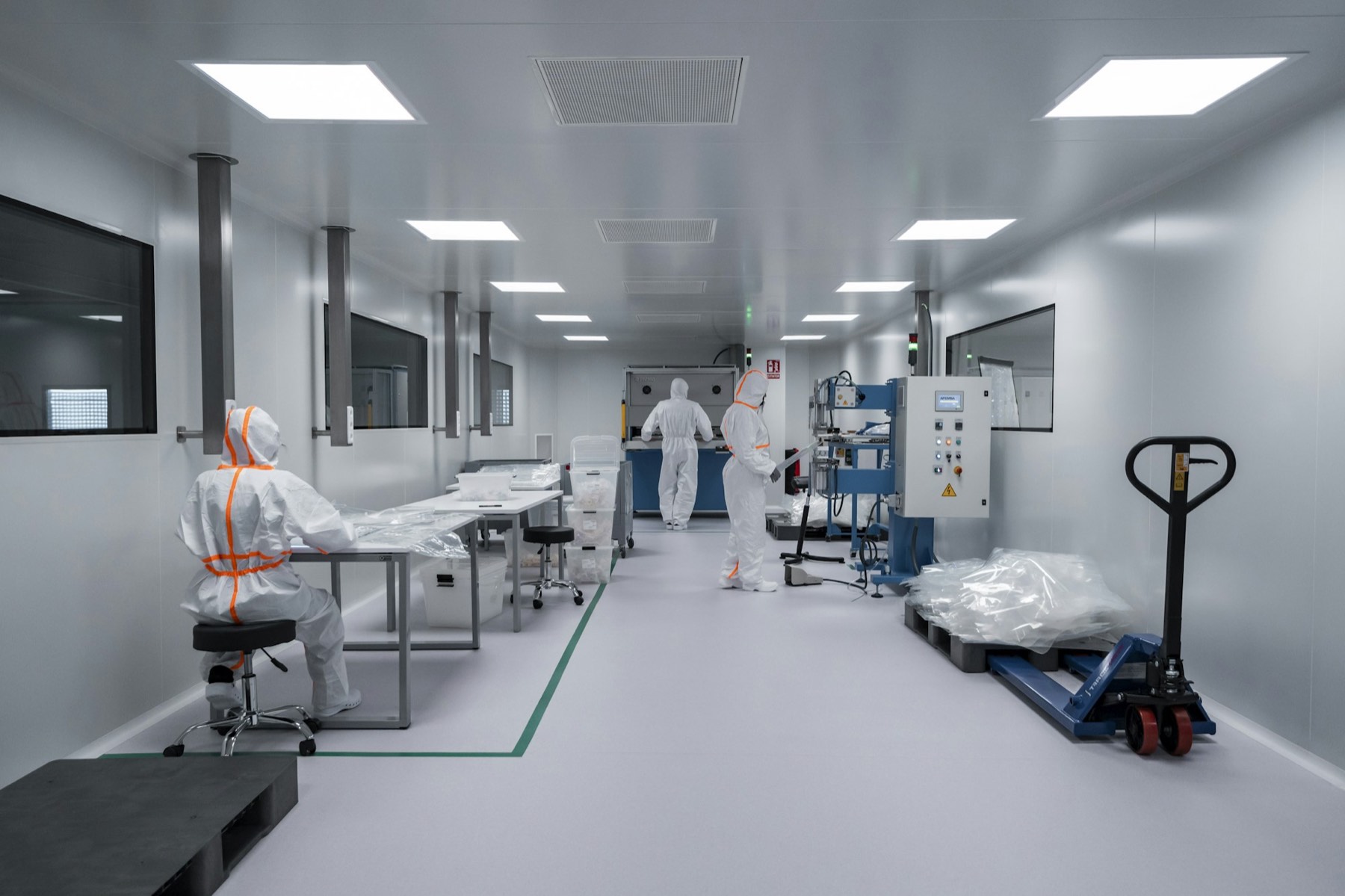
Why the two conflict
A standard lab keeps fumes and agents from reaching people, so air flows into the lab. A cleanroom keeps particles from reaching the work, so air flows out of the room.
Many labs need both. Annex 1 para 4.14 says pressure advice may change where hazardous material must be contained. The design may then use positive or negative pressure airlocks so the hazard does not reach the surrounding areas.
Another route is local protection. Keep the lab itself conventional and place the clean work in a hood or cabinet. Choose by the hazard and the class you need.
Rules that move the numbers
Cornell says higher rates may apply to labs with greater hazards, and lower rates may suit low-hazard or write-up spaces. Lab staff cannot adjust the rates.
FDA recommends continuous monitoring of pressure differences between cleanrooms, frequent recording, documentation of every alarm and investigation of deviations. It also gives at least 12.5 Pa over an unclassified room next to the aseptic area.
Annex 1 says that where containment needs air to flow into a critical zone, the air should come from a room of the same or a higher grade (para 4.14).
Questions to settle first (suggested)
What is the hazard? What class does the work need? Which way must air flow? Who enters, and how do samples and waste leave?
Answer these before you pick air changes. Pressure direction and class decide the layout. Air changes follow.
Worked example (calculated)
Assume a lab of 40 m² and 3 m height, or 120 m³. At 6 air changes per hour the supply is 720 m³/h. At 8 it is 960 m³/h. At 20 it is 2,400 m³/h. The cleanroom figure is 3.3 times the 6 air change figure.
So an owner who adds a cleanroom zone to a lab should size the air plant and the ducts for the larger flow. Treat a classified room as its own project line, not as a lab with filters.
A classified room also adds work after handover. It needs classification tests and routine monitoring that a standard lab room may not need, so plan the staff time for them.
If you have a room list for a laboratory project, send it to ZY Cleanroom and we will review the panel, door and ceiling scope with you.
Questions
Common questions
Is 6 air changes per hour a legal minimum?
No. It is the rule on one university's page. National and local codes differ.
Can a lab be both clean and contained?
Annex 1 para 4.14 allows modified pressure design with positive or negative pressure airlocks where material must be contained.
What are the unoccupied rates?
Cornell lists 3 per hour for a 6 occupied design and 4 per hour for an 8 occupied design.
Which ISO class do I need for a lab?
These sources do not set one. Choose it from your process and write it as a design input.
Related guides
- How long does it take to build a cleanroom?
- How to audit a cleanroom panel factory, on site or by video
- The Cleanroom Project Lifecycle
- Writing a cleanroom URS: contents and testable wording
- Turnkey cleanroom contractor
- Room list builder
Sources
- Cornell University EHS, 4.16 Laboratory Ventilation Rates and Pressure Relationships (undated web page; checked 1 November 2026)
- FDA, Guidance for Industry: Sterile Drug Products Produced by Aseptic Processing, Current Good Manufacturing Practice (September 2004, nonbinding; checked 1 November 2026)
- EudraLex Volume 4, Annex 1: Manufacture of Sterile Medicinal Products (published 25 August 2022, applied from 25 August 2023; checked 1 November 2026)
Project enquiry
Send what you have
A room list, a floor plan or only the floor area is enough to start. After you submit, send drawings by email or WhatsApp.
We reply by email within one working day. We can sign an NDA before you send drawings.
WhatsApp +44 7962 561184 is our UK number for export enquiries. The factory is in Tianjin, China.
Email: [email protected]
WhatsApp: +44 7962 561184