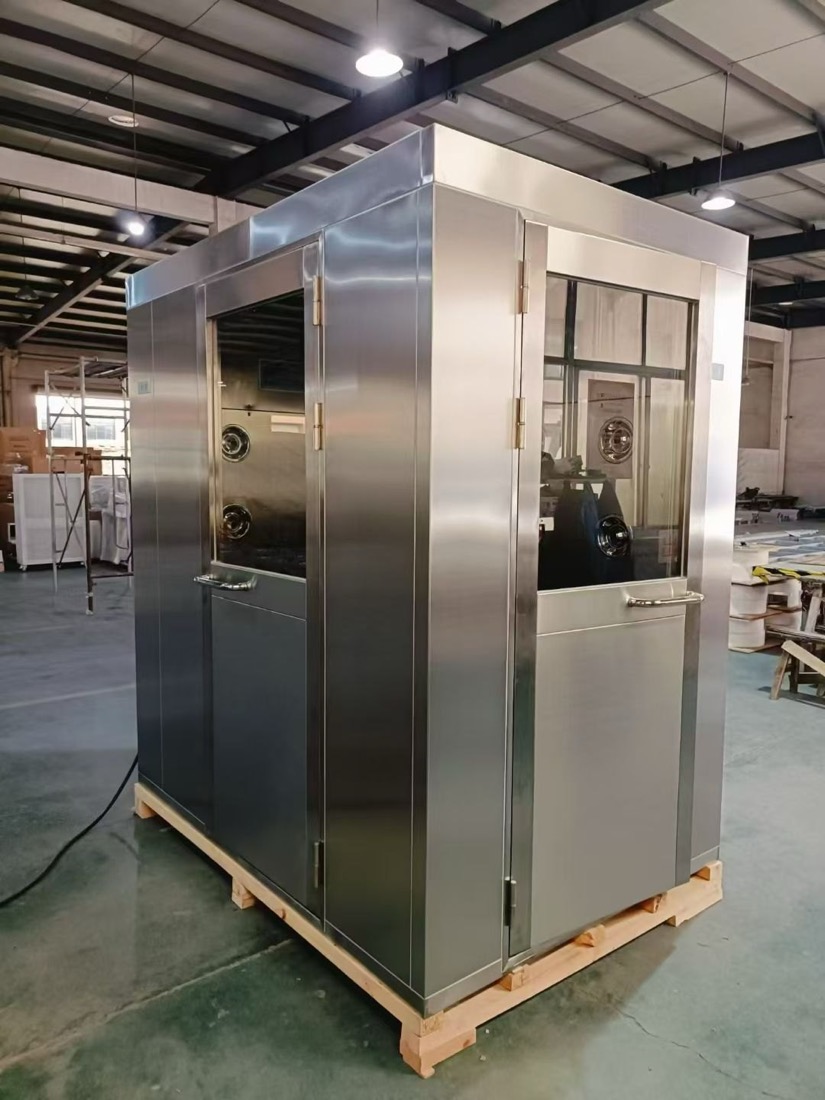
Cleanroom Air Showers
An air shower blows filtered air over people or cargo before they enter a cleanroom. Buyers are cleanroom owners and contractors who plan the personnel or material entry and want it quoted with the panels, doors and pass boxes.
Best for
- Personnel entry to pharmaceutical clean areas
- Food and beverage entries and material locks
- Electronics cleanroom entrances
- Hospital and laboratory access points
- Trolley and cargo entries
Specifications
Typical specification
| Types | Personnel (single or double person) and cargo |
|---|---|
| Single personnel unit (typical) | 900 × 1200 × 2150 mm (W × D × H); 6–12 HEPA nozzles |
| Double personnel unit (typical) | 1400 × 1200 × 2150 mm (W × D × H); 12–24 HEPA nozzles |
| Cargo unit (typical) | 1800 × 1500 × 2200 mm or more (W × D × H); 10–20 HEPA nozzles |
| Blow time | 10–30 s adjustable (personnel); 20–60 s (cargo) |
| Controls | PLC and door interlock; cargo units with roll-up door |
| Door interlock | Stops both doors opening at once; air-lock versions add a buffer zone |
| Sizes | Typical catalogue sizes only. The offered model, passage and drawing are confirmed in the quotation |
| Supply | Supplied with your panels and doors in one quotation, so sizes and openings match; each unit is inspected before shipping |
Options
What you can specify
- Single or double person air shower
- Cargo air shower for trolleys and loads
- Air-lock version with a buffer zone
- Roll-up door on cargo units
- Unit matched to your panel opening and ceiling height, confirmed in the quotation
How to choose an air shower
Choose by who or what passes through. For people, define how many pass per shift and at peak, and how many stand in the unit per cycle. For cargo, define the largest packaged load or trolley and its route.
Cargo units are wider and taller than personnel units and often have a roll-up door. An ISO class alone does not decide whether an air shower is needed. The entry procedure and the contamination-control plan decide it.
How an air shower works
| Step | What happens |
|---|---|
| 1 | The person or cargo enters and the outer door closes. The inner door stays locked. |
| 2 | A fan draws air from the chamber through a pre-filter and a HEPA filter. |
| 3 | The filtered air leaves through nozzles in the walls, and on some models the ceiling, at high speed, aimed at the body or the load. It returns to the fan through low grilles, so the chamber recirculates its own air. |
| 4 | When the blow cycle ends, the inner door unlocks. The two doors are never open together. |
Ask for the nozzle exit velocity measured with a calibrated anemometer, the cycle time, the filter class and the door lock logic of the offered model. See air shower and pass box selection.
What an air shower can and cannot do
A published test is worth knowing before you buy. In a study by Whyte and McGeorge (Microcontamination, 1994), gowned volunteers went into an ISO 5 room through an air shower tunnel, and also through a bypass. The tunnel removed about 50%, 80% and 90% of particles of 5, 10 and 30 µm from garment surfaces, but not particles under 2 µm. Particle counts in the cleanroom did not differ between shower and bypass. Most particles came from under the garments, at ankles, cuffs and neck, which a surface air jet does not reach.
What this means for your entry design:
- An air shower can remove some large particles from the outside of garments and loads.
- It does not replace correct gowning, garment laundering or the airlock. In that test, the barrier effect came from the airlock, not the shower. See gowning room design and cleanroom airlock design.
- Whether to fit one is a decision for your contamination control strategy. EU GMP Annex 1 does not mention air showers.
Air shower size and dimensions: size it by throughput
No standard sets a cycle time or nozzle velocity, so size the unit by how many people must pass at the busiest time.
Assumed numbers, for illustration only: a 30 s cycle, one person at a time, 20 people arriving in the 15 minutes before a shift. That is 20 × 30 = 600 s, or 10 of the 15 minutes. With little margin, compare a double-person unit or a second unit. Use your own shift numbers.
| Unit | Typical external size (W × D × H) | Nozzles | Use when |
|---|---|---|---|
| Single personnel | 900 × 1200 × 2150 mm | 6–12 | Low to moderate peak traffic |
| Double personnel | 1400 × 1200 × 2150 mm | 12–24 | Two people per cycle, higher peak |
| Cargo | 1800 × 1500 × 2200 mm or more | 10–20 | Trolleys and packaged loads |
Air shower design: where it sits in the entry
EU GMP Annex 1 does not name air showers. Its personnel route is a changing room that works like an airlock (paras 4.1 and 4.12). If you fit an air shower, treat its two doors as an interlocked pair:
- Doors into Grade A or B areas: interlocked, not open together (Annex 1, para 4.13).
- Doors into Grade C or D areas: a visual or audible warning as a minimum (Annex 1, para 4.13).
- A time delay between one door closing and the other opening, where needed (Annex 1, para 4.13).
Plan the air shower with the gowning room, not after it. See gowning room design and airlock design.
An air shower and an airlock are not the same. The EU GMP Annex 1 glossary defines an airlock as an enclosed space with interlocked doors that keeps a pressure difference between adjacent rooms; blowing air is not part of that definition. An air shower adds the filtered air blow. An air-lock version with a buffer zone is available where you need both.
Air shower specifications to state in an enquiry
Send the entry layout, clear opening, users or cargo size, voltage and frequency, and the destination. Give the clear internal passage separately from the external unit size. Add the panel thickness, ceiling clearance, floor level and threshold. State the door mechanism, interlock sequence, emergency release, cleaning agents and who tests the unit.
Quote checklist
| Send | Why |
|---|---|
| Personnel or cargo, and people per cycle | Sets the unit type |
| Peak people per hour, or largest load with packaging | Sets the size |
| Clear internal passage and external unit size, separately | So the unit fits the opening |
| Panel wall thickness, ceiling clearance, floor level | Fixing and sealing to the wall |
| Voltage and frequency | Fans and controls |
| Interlock sequence, delay, emergency release, power-cut rule | Safety and entry procedure |
| Final filter class and leak test access | Filter tested in place to ISO 14644-3 |
| Destination country | Plug, voltage, packing |
What goes wrong on site
The external unit does not fit the opening, or door movement hits a wall. Check the unit size, fixings and door swing against the site drawing. Filter access is often forgotten, so leave room to replace filters.
Cycle time and nozzle settings depend on your entry procedure. Ask for the offered model's settings and test results.
Air shower and pass box selection
Questions
Common questions
What is an air shower?
A chamber at the entry to a cleanroom. Nozzles blow filtered air over a person or load for a set cycle, then the inner door opens. The doors are interlocked so they do not open at the same time.
How does an air shower work?
A fan pulls air through a pre-filter and a HEPA filter and blows it out of nozzles onto the person or load for a set cycle. The air recirculates inside the chamber. The inner door unlocks only when the cycle ends.
What are air showers used for?
At personnel and cargo entries to pharmaceutical, food and beverage, electronics, hospital and laboratory cleanrooms. Filtered air jets remove some large particles from garments and loads before entry. An air shower adds to gowning and the airlock; it does not replace them.
Do air showers actually work?
They remove some large particles from garment surfaces, but a published test found they did not lower particle counts in the cleanroom itself. Treat an air shower as an addition to gowning and an airlock, not a replacement for them.
What is the difference between an air shower and an airlock?
An airlock separates rooms and holds a pressure difference; an air shower also blows filtered air over people or loads. EU GMP Annex 1 describes airlocks and changing rooms but does not mention air showers. Whether you need one is decided by your contamination control plan.
How do I compare single-person and multi-person air showers?
Compare peak throughput, usable passage space, the agreed occupancy and the whole entry sequence. Ask for drawings and cycle details for each offered model, not just the category name or external width.
What blow time should I ask for?
Catalogue personnel units list 10 to 30 seconds, adjustable, and cargo units 20 to 60 seconds. The right setting depends on your entry procedure. Ask for the offered model's settings, measurement conditions and test results.
Can an air shower fit an existing panel opening?
Send the opening dimensions, panel thickness, floor level and service space. We check the external unit size, fixing and sealing, and door movement against the site drawing.
What should the delivery and acceptance scope include?
List drawings, equipment identification, operating and maintenance instructions, interlock checks and any agreed performance tests. Confirm who tests, by what method and to what criteria before approval.
Does EU GMP require an air shower?
No. Annex 1 does not mention air showers. It describes changing rooms that work like airlocks. Whether to add an air shower is a decision from your own contamination-control plan. If you fit one, interlock its doors as you would an airlock's.
Can the air shower be quoted with the panels and doors?
Yes. Air showers are quoted with the panels, doors and pass boxes for the same layout, so the opening sizes and wall thickness match.
What sets the price of an air shower?
The specification: personnel or cargo, people per cycle, unit size, number of doors and the door type, body material, nozzle count, filter class, controls and interlock, and whether installation and the filter test are included. To compare offers, send each supplier the same data sheet; see air shower cost. The price is confirmed in a written quotation.
Who installs the air shower?
On a turnkey contract, our own crew installs the air shower with the panels and doors. On a supply-only order, your contractor installs it to the drawing of the offered model. In both cases, check the interlock and the filter before use; see air shower interlocks.
Can I order an air shower for a project outside China?
Yes. Air showers are part of our cleanroom product range and are included in one quotation with the panels, doors and pass boxes, so openings and wall thickness match. Each unit is inspected before shipping. Send the opening size, the number of people per shift and the project city.
Project enquiry
Send what you have
A room list, a floor plan or only the floor area is enough to start. After you submit, send drawings by email or WhatsApp.
We reply by email within one working day. We can sign an NDA before you send drawings.
WhatsApp +44 7962 561184 is our UK number for export enquiries. The factory is in Tianjin, China.
Fastest reply: message us on WhatsApp. Or use the form, and add your WhatsApp number so we can reply there.
Email: [email protected]
WhatsApp: +44 7962 561184