Buyer guide
Pharmaceutical cleanroom zoning: grades, airlocks and pressure steps
Zone a sterile pharmaceutical plant by grade A to D, with an airlock at each grade step and air flowing from the cleanest room outward. EU GMP Annex 1 gives a guidance value of at least 10 Pa between adjacent rooms of different grade, and FDA's 2004 guidance gives at least 10 to 15 Pa.
By ZY Cleanroom · Updated · Sources at the end of the page
The four grades
Annex 1 sets total particle limits at rest and in operation (Table 1, para 4.27). It also sets action limits for microbes in air (Table 6, para 9.30). The use column is a short summary of paras 4.4, 8.6 and 8.10.
| Grade | Particles ≥0.5 µm/m³, at rest | In operation | Air, cfu/m³ action limit | Typical use |
|---|---|---|---|---|
| A | 3,520 | 3,520 | No growth | Filling zone, stopper bowl, aseptic connections |
| B | 3,520 | 352,000 | 10 | Background to grade A |
| C | 352,000 | 3,520,000 | 100 | Solution preparation for filtering; filling of terminally sterilised product |
| D | 3,520,000 | Not predetermined | 200 | Equipment cleaning; preparation of solutions and components for later filling of terminally sterilised product |
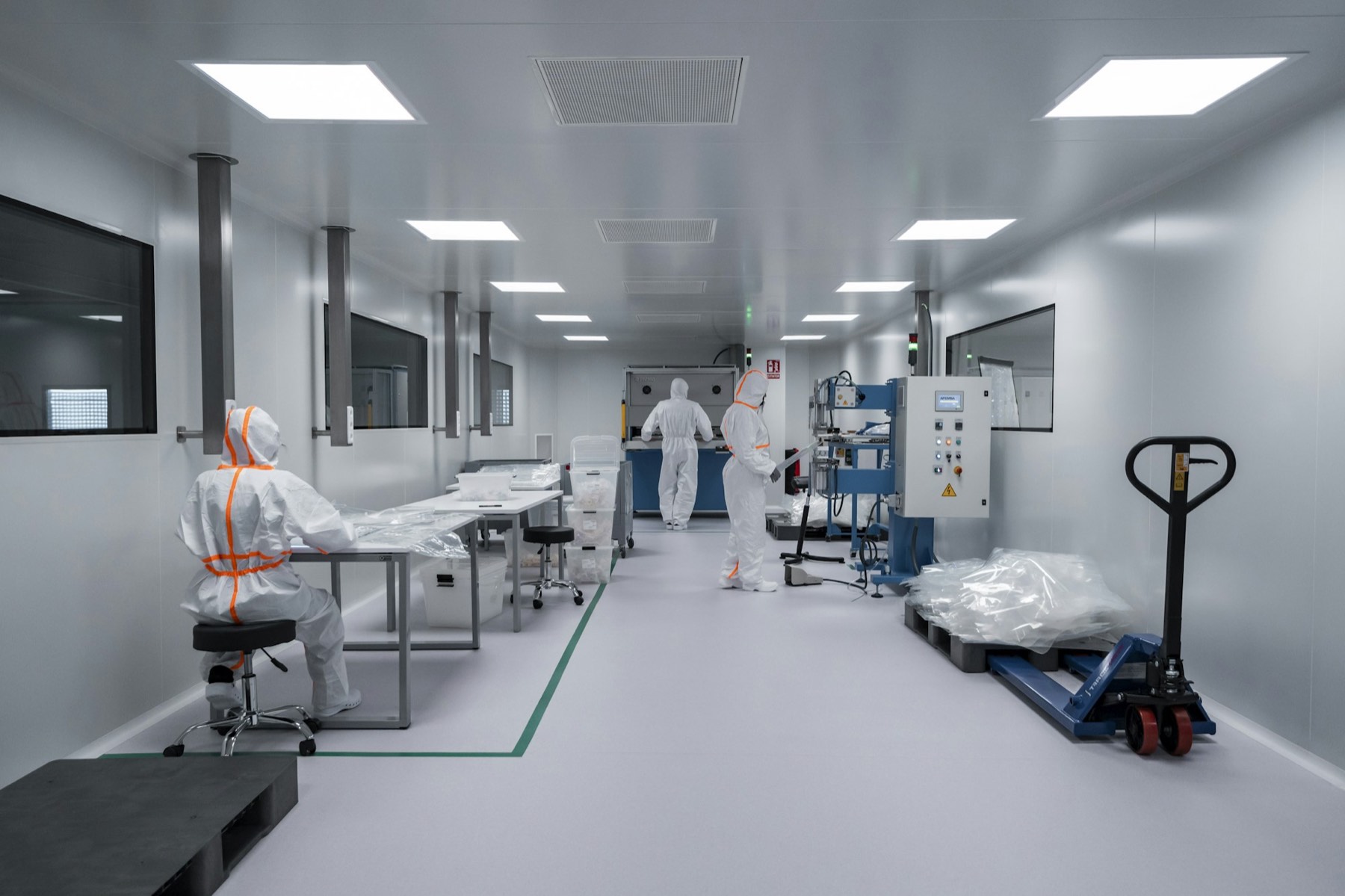
Zoning rules that drive the layout
Entry to cleanrooms goes through change rooms that act as airlocks (para 4.1). Airlocks should be present between different grades. Separate airlocks for people and for materials where possible (para 4.12).
The last stage of an airlock should match the grade of the room it leads to, in the at-rest state (para 4.12). Airlocks to grade A and B need interlocked doors. Airlocks to grade C and D need at least a visual or audible warning (para 4.13).
Sinks and drains are not allowed in grade A and B (para 4.9). Surfaces must be smooth, impervious and unbroken, and ceilings must be sealed against the space above (paras 4.5 and 4.8).
Fit pressure indicators between rooms. Critical pressure differences need continuous monitoring, recording and an alarm (para 4.16).
Transfers, windows and airflow proof
Annex 1 calls the movement of equipment and materials one of the greatest potential sources of contamination (para 4.10). Transfer into grade A or B should be one-way, ideally through double-ended sterilisers sealed into the wall (para 4.11). Removal uses a separate one-way route, or time separation by procedure.
Grade A and B areas should allow observation from outside, through windows or remote cameras (para 4.17). Airflow patterns must be shown by visualisation studies, at rest and in operation, and the video kept (para 4.15).
FDA's 2004 guidance says the area next to the aseptic line should be at least ISO 7 in operation. The maker may class it ISO 6, or hold the whole filling room at ISO 5. ISO 8 suits less critical work such as equipment cleaning.
Pressure and air change figures
FDA's 2004 guidance says at least 10 to 15 Pa should be held between adjacent rooms of different class, with doors closed. It gives at least 12.5 Pa over an unclassified room next to the aseptic area. It says at least 20 air changes per hour is typically acceptable for ISO 8 supporting rooms and much higher for ISO 7 and ISO 5.
Annex 1 says pressure advice may change where hazardous material must be contained. Then the design may use positive or negative pressure airlocks (para 4.14).
Worked example (arithmetic, not a standard)
Take the 10 Pa minimum step from Annex 1. A chain of an unclassified corridor, grade D, grade C and grade B has three steps. The grade B room then sits at least 30 Pa above the corridor. The real set points come from the contamination control strategy, not from this sum.
This guide covers sterile products only. For non-sterile products, check the GMP rule of your market.
If you have a room list and grade plan for a pharmaceutical project, send it to ZY Cleanroom and we will review the panel, door and ceiling scope with you.
Questions
Common questions
Does terminal sterilisation need grade B?
Not in Annex 1 Table 3. It lists grade D for solution and component preparation, grade C for filling and for preparation when unusually at risk, and grade A for filling when unusually at risk.
What does at rest mean?
Para 4.29 defines it as services installed and HVAC running, main equipment installed but not operating, and no people in the room.
How fast must a room recover?
Annex 1 gives a guidance value of under 20 minutes for the clean-up period, set during qualification (para 4.29).
Is 10 Pa a fixed rule?
Annex 1 calls it a guidance value. Set the design value from your risk review and keep alarms on the critical pairs.
What regulations govern pharmaceutical cleanrooms?
It depends on where the plant is and where it sells. EU GMP Annex 1 covers sterile products in the EU, the FDA's 2004 aseptic guidance is the US reference, and many other countries use PIC/S or WHO GMP. ISO 14644 gives the classification method. A regulator approves the owner's facility, not the contractor.
Is ISO 14644-1 enough for a GMP cleanroom?
No. ISO 14644-1 classifies air by particle count only. GMP also covers microbial limits, pressure, airflow proof, gowning, monitoring and qualification, so a class certificate is one part of the file.
Related guides
- How long does it take to build a cleanroom?
- What a cleanroom costs to run: energy, filters and testing
- How to audit a cleanroom panel factory, on site or by video
- Cleanroom cost per m²: published ranges by ISO class
- Turnkey cleanroom contractor
- Room list builder
Sources
- EudraLex Volume 4, Annex 1: Manufacture of Sterile Medicinal Products (published 25 August 2022, applied from 25 August 2023; checked 1 November 2026)
- FDA, Guidance for Industry: Sterile Drug Products Produced by Aseptic Processing, Current Good Manufacturing Practice (September 2004, nonbinding; checked 1 November 2026)
Project enquiry
Send what you have
A room list, a floor plan or only the floor area is enough to start. After you submit, send drawings by email or WhatsApp.
We reply by email within one working day. We can sign an NDA before you send drawings.
WhatsApp +44 7962 561184 is our UK number for export enquiries. The factory is in Tianjin, China.
Email: [email protected]
WhatsApp: +44 7962 561184