Buyer guide
Cleanroom monitoring systems: particles, pressure, temperature and humidity
A cleanroom monitoring system logs particles, room pressure differences, temperature and humidity, and raises alarms against limits you set. EU GMP Annex 1 asks for continuous particle monitoring in Grade A at a sample flow of at least 28 litres per minute, and USP <797> asks for a pressure monitoring device that runs continuously.
By ZY Cleanroom · Updated · Sources at the end of the page
What to monitor
Each parameter has its own rule. Match the system to the rooms on your list.
| Parameter | Reference | Source |
|---|---|---|
| Particles, Grade A | Continuous for 0.5 and 5 µm; at least 28 L/min | Annex 1, para 9.17 |
| Particles, Grade B | Similar system recommended; frequency may be lower | Annex 1, para 9.18 |
| Pressure, critical | Continuous and recorded; instant warning on loss | Annex 1, para 4.16 |
| Pressure, FDA | Continuous through each shift, frequently recorded | FDA, 2004 |
| Pressure, pharmacy | Continuous; reviewed and documented at least daily | USP <797>, 4.2.5 |
| Temperature, humidity | Controlled to product, process and personnel needs | Annex 1, para 9.6 |
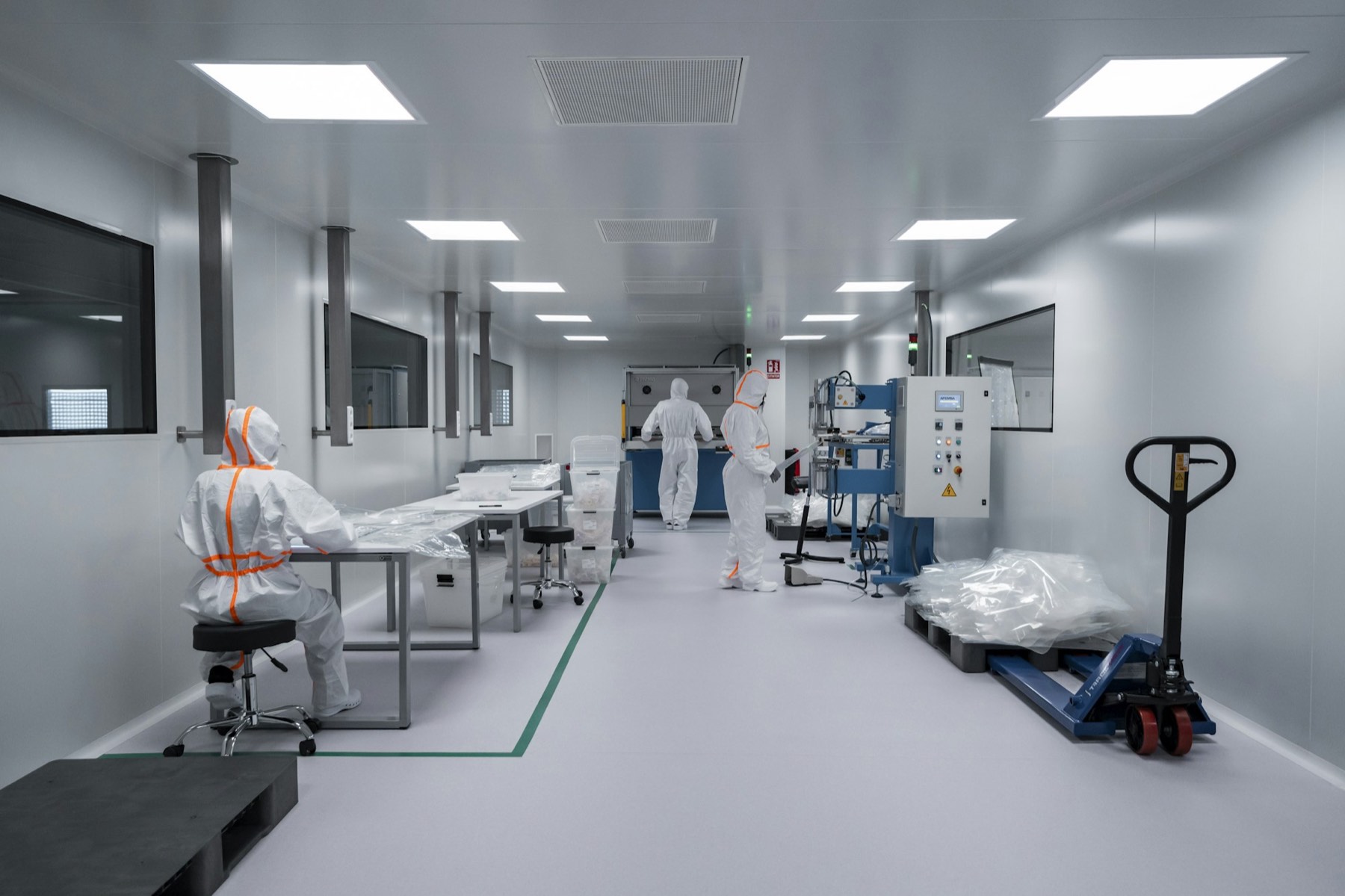
Particle limits for monitoring
Table 5 of Annex 1 gives the maximum total particle limits per cubic metre. They act as action limits. Set alert levels lower, from qualification results and trend data.
| Grade | 0.5 µm at rest | 0.5 µm in operation | 5 µm at rest | 5 µm in operation |
|---|---|---|---|---|
| A | 3,520 | 3,520 | 29 | 29 |
| B | 3,520 | 352,000 | 29 | 2,930 |
| C | 352,000 | 3,520,000 | 2,930 | 29,300 |
| D | 3,520,000 | Not predetermined | 29,300 | Not predetermined |
Sampling hardware
Annex 1 para 5.9 asks for qualified particle counters, including the tubing. Tube length should typically be no more than 1 m, with few bends. Use isokinetic heads in unidirectional flow, close to the critical location.
Monitoring sample volumes may differ from classification volumes if justified (para 9.21). Keep qualification separate from routine monitoring (para 4.24). ISO 14644-1 points to ISO 21501-4 for the counter specification.
Alarms and response
Annex 1 asks that critical pressure alarms are not overridden without assessment. It asks that any alarm delay is assessed and justified (para 4.16).
If an action limit is exceeded, procedures should require a root cause investigation and a product impact assessment (para 9.13). An alert level calls for assessment and follow-up.
Write the monitoring plan first
ISO 14644-2:2015 sets out the plan in clauses on risk assessment (4.2), the plan itself (4.3), calibration (4.4), review and approval (4.5) and response to a deviation (4.6). Annex B covers alert and action levels. Choose sensor points from that plan, not the other way round.
Put these in the data sheet
State each point, parameter, range, calibration interval, alarm limit, delay and recipient. State record retention and trend reports. State how readings are kept if the network fails.
Temperature, humidity and microbes
US drug law (21 CFR 211.42 and 211.46) calls for temperature and humidity controls and a system for monitoring environmental conditions in aseptic areas. Annex 1 para 4.25 adds temperature and humidity tests to qualification.
Particle counters do not measure microbes. Annex 1 para 9.22 lists settle plates, volumetric air sampling, and glove, gown and surface samples. It asks for continuous viable monitoring in Grade A during critical processing (para 9.24).
FDA says pressure alarms should show an emerging low-pressure fault early enough to stop unclassified air entering a classified room.
Who approves the room
Your regulator judges the facility, not the contractor. The contractor installs the system to your data sheet and supplies calibration and test records. To have a room list reviewed, send it to ZY Cleanroom, a cleanroom design-and-build contractor with its own panel factory in Tianjin, China.
Questions
Common questions
Does every cleanroom need continuous particle monitoring?
Annex 1 requires it in Grade A and recommends a similar system for Grade B. Other rooms follow your risk-based plan.
How long can a particle sample tube be?
Annex 1 says typically no longer than 1 m unless justified, with few bends.
How often should pressure be read?
FDA says continuously through each shift. USP <797> requires a continuous device and a daily review on compounding days.
What are alert and action limits?
Annex 1 Table 5 gives the action limits. Alert levels come from qualification results and trends, and sit below them.
Related guides
- Cleanroom failed particle count: causes and fixes
- Cleanroom pressure differentials: cascades, values, monitoring
- HEPA and ULPA filters: EN 1822, ISO 29463 and integrity testing
- Cleanroom temperature and humidity requirements
- Turnkey cleanroom contractor
- Room list builder
Sources
- EudraLex Volume 4, Annex 1: Manufacture of Sterile Medicinal Products (published 25 August 2022, applied from 25 August 2023; checked 31 October 2026)
- FDA, Guidance for Industry: Sterile Drug Products Produced by Aseptic Processing, Current Good Manufacturing Practice (September 2004, nonbinding; checked 31 October 2026)
- Washington State Department of Health, Pharmacy Self-Inspection Worksheet, 2026 USP 797 Sterile Compounding Addendum, DOH 690-296 (January 2026), which reproduces USP <797> text by section; checked 31 October 2026
- DIN EN ISO 14644-2:2016-05, Cleanrooms and associated controlled environments, Part 2: Monitoring to provide evidence of cleanroom performance related to air cleanliness by particle concentration (ISO 14644-2:2015), contents list; checked 31 October 2026
- ISO 14644-1:2015 preview on iTeh Standards, definition of light scattering airborne particle counter, reference to ISO 21501-4 (preview copy; checked 31 October 2026)
Project enquiry
Send what you have
A room list, a floor plan or only the floor area is enough to start. After you submit, send drawings by email or WhatsApp.
We reply by email within one working day. We can sign an NDA before you send drawings.
WhatsApp +44 7962 561184 is our UK number for export enquiries. The factory is in Tianjin, China.
Email: [email protected]
WhatsApp: +44 7962 561184