Buyer guide
Cleanroom pressure differentials: cascades, values, monitoring
A pressure cascade holds each room above the less clean room beside it, so air leaks from clean to less clean and not the other way. Published minimums are small: EU GMP Annex 1 gives 10 Pa as a guidance value, FDA's 2004 guidance gives 10 to 15 Pa, and China's 2010 GMP gives not less than 10 Pa.
By ZY Cleanroom · Updated · Sources at the end of the page
Published values
Values differ by sector, so state yours in the user requirements.
| Source | Value | Applies to |
|---|---|---|
| EU GMP Annex 1, 2022, para 4.14 | At least 10 Pa (guidance value) | Adjacent rooms of different grades |
| FDA aseptic guidance, 2004 | At least 10 to 15 Pa (0.04 to 0.06 in. wg), doors closed | Adjacent rooms of different classification |
| FDA aseptic guidance, 2004 | At least 12.5 Pa | Aseptic room against an unclassified room |
| FDA aseptic guidance, 2004 | About 17.5 to 50 Pa | Isolators against surroundings |
| China GMP, 2010 revision, Art. 48 | Not less than 10 Pa | Clean to non-clean areas, and between clean grades |
| UK HTM 03-01 Part A, 2021 | Theatre 25 Pa, lay-up room 35 Pa, critical care room +5 Pa, isolation room −5 Pa | Hospital rooms |
| India NABH, 2018 | At least 2.5 Pa | Operation theatre against adjoining areas |
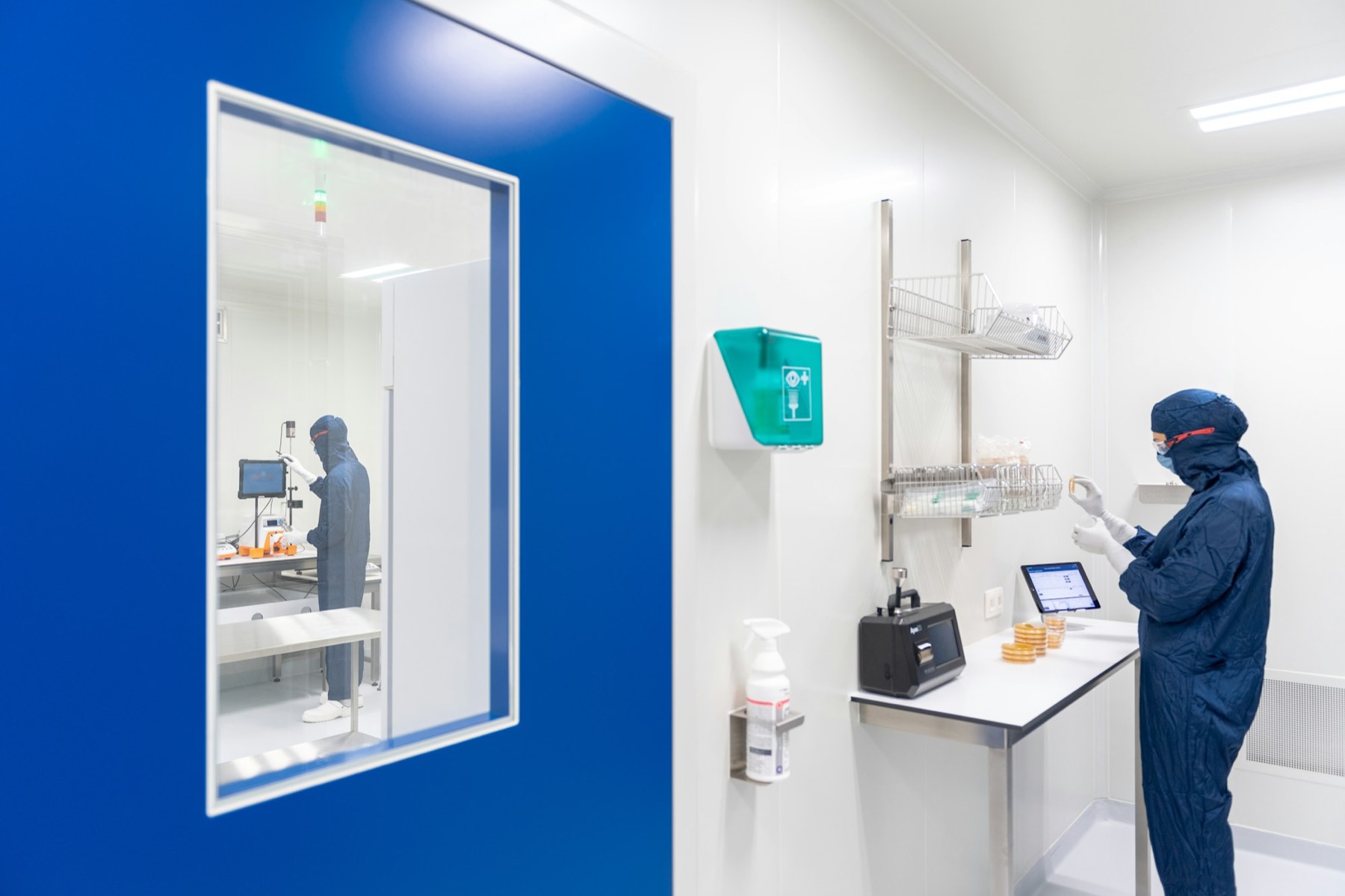
Building a cascade
With 10 Pa steps, a chain of four rooms puts the cleanest room 30 Pa above the unclassified corridor, as the table shows. That is arithmetic from the guidance value, not a requirement. Other steps may be justified by the process.
10 Pa is about 1 mm of water gauge. Force on a door is pressure times area, so 25 Pa on a 1.0 × 2.1 m door is 52.5 N.
Rooms handling pathogenic, highly toxic or radioactive material may need the cascade changed, including negative-pressure airlocks (Annex 1, para 4.14). HTM 03-01 gives −5 Pa to the general area for category 2 isolation rooms (Table 4).
| Room | Example grade | Pressure above corridor |
|---|---|---|
| Corridor | Unclassified | 0 Pa |
| Gowning airlock | Grade D | 10 Pa |
| Preparation room | Grade C | 20 Pa |
| Filling room | Grade B | 30 Pa |
Doors and airlocks
Pressure falls when a door opens. HTM 03-01 separates closed-door protection, where leakage flows from clean to less clean, from open-door protection, where airflow through the doorway replaces the lost pressure (para 8.18). A 1.4 m wide open doorway can pass 0.19 m³/s each way with no temperature difference (para 8.17).
Without pressure stabilisers or transfer grilles, doors are held partly open by air pressure (para 8.24).
Pressure stabilisers set the room differential with doors shut and close when a door opens, so air is forced through the doorway. They work in one direction only. Transfer grilles pass air both ways between rooms of equal class and pressure (paras 8.19 and 8.23). Lock windows shut or seal them where pressure is critical (para 8.20).
What to monitor
Fit pressure indicators between cleanrooms. Annex 1 says the warning signal should not be overridden without assessment.
| Item | Practice | Source |
|---|---|---|
| Critical differentials | Monitor continuously and record. Warn at once on failure or a drop below the set limit. | Annex 1, para 4.16 |
| Other differentials | Monitor and record at regular intervals. | Annex 1, para 4.16 |
| Alarm delays | Assess and justify. | Annex 1, para 4.16 |
| Frequency and alarms | Continuous through each shift, frequently recorded. Document alarms and investigate deviations. | FDA, 2004 |
| Airflow direction | Visualise airflow at rest and in operation. Pressure alone does not show flow direction. | Annex 1, para 4.15 |
Who approves the room
The regulator approves the owner's facility, not the contractor. The contractor supplies pressure test results against your limits. To have a room list reviewed, send it to ZY Cleanroom, a cleanroom design-and-build contractor with its own panel factory in Tianjin, China.
Questions
Common questions
What pressure difference should a cleanroom have?
Commonly at least 10 Pa between adjacent grades: EU GMP Annex 1, China GMP 2010 and FDA (10 to 15 Pa). Hospital values differ: 2.5 Pa minimum in NABH, 25 Pa for a UK theatre.
Is higher pressure always better?
No. HTM 03-01 warns that rooms without relief paths hold doors partly open by air pressure.
Which rooms run at negative pressure?
Containment and infectious-disease rooms. HTM 03-01 gives −5 Pa for category 2 isolation rooms.
How often should pressure be recorded?
Annex 1 says critical differences should be monitored and recorded continuously and others at regular intervals. FDA says continuously through each shift.
How do you calculate a cleanroom pressure differential?
You do not calculate the pressure itself. Set the target, estimate the leakage through door gaps and other openings at that pressure, then make supply air minus extract air equal that leakage. Leakage grows with roughly the square root of pressure, so doubling the step takes about 1.4 times the air. Real gaps differ, so confirm by measurement.
What does a pressure relief damper do in a cleanroom?
It sets the room pressure with the doors shut by letting surplus air out at a set point. HTM 03-01 calls these pressure stabilisers and says they close when a door opens, which forces air through the doorway (para 8.19). Place them so that air moves from clean to less clean.
Related guides
- ISO 5 and ISO 6 cleanroom requirements
- ISO 7 and ISO 8 cleanroom requirements
- Cleanroom failed particle count: causes and fixes
- Cleanroom temperature and humidity requirements
- Turnkey cleanroom contractor
- Room list builder
Sources
- EudraLex Volume 4, Annex 1: Manufacture of Sterile Medicinal Products (published 25 August 2022, applied from 25 August 2023; checked 31 October 2026)
- FDA, Guidance for Industry: Sterile Drug Products Produced by Aseptic Processing, Current Good Manufacturing Practice (September 2004, nonbinding; checked 31 October 2026)
- Ministry of Health of China, Good Manufacturing Practice for Drugs (2010 revision), Order No. 79, Article 48 (in force 1 March 2011; checked 31 October 2026)
- NHS England, Health Technical Memorandum 03-01, Specialised ventilation for healthcare premises, Part A (published 22 June 2021; checked 31 October 2026)
- NABH, Revised Guidelines for Air Conditioning in Operation Theatres (issue 4, November 2018; checked 31 October 2026)
Project enquiry
Send what you have
A room list, a floor plan or only the floor area is enough to start. After you submit, send drawings by email or WhatsApp.
We reply by email within one working day. We can sign an NDA before you send drawings.
WhatsApp +44 7962 561184 is our UK number for export enquiries. The factory is in Tianjin, China.
Email: [email protected]
WhatsApp: +44 7962 561184