Buyer guide
Injection Moulding Cleanrooms for Medical Device Parts
Medical device makers usually plan injection moulding rooms at ISO 7 or ISO 8, but the class comes from the device maker's own risk assessment and the rules of its market, not from the machine. The main design questions are where the moulding machines stand, how much heat they put into the room, how resin, parts and people move, and which way the air pressure steps. A room list with the machine schedule and heat loads is enough to start a quote.
By ZY Cleanroom · Updated · Sources at the end of the page
Which class does a moulding room need?
Our medical device industry page lists ISO 7–8 as the common range for injection moulding, device assembly and sterile barrier packaging, with gowning at ISO 8. These are typical values, confirmed with your process, product and regulator.
| ISO class | Old US name | Max particles ≥0.5 µm per m³ (ISO 14644-1) |
|---|---|---|
| ISO 7 | Class 10,000 | 352,000 |
| ISO 8 | Class 100,000 | 3,520,000 |
Three things decide the class in practice:
- How the finished device touches the body. China's NMPA annex for sterile medical devices (Announcement 2015 No. 101) sets a minimum class by contact type for final cleaning, assembly, primary packing and sealing: Class 10,000 (ISO 7) for devices implanted or placed in blood vessels, Class 100,000 (ISO 8) for contact with blood, bone marrow or non-natural openings, and Class 300,000 for contact with damaged skin or mucosa. Other markets have their own rules; ask your regulator which apply. The base GMP was revised by NMPA Announcement 2025 No. 107, in force 1 November 2026, so ask your regulator which annex text applies to your product.
- Whether moulding is the last step before packing. If a moulded part goes straight to primary packing with no later cleaning, the moulding room is effectively part of the clean process. If parts are cleaned afterwards, the moulding area may sit in a lower class. Your risk file decides.
- The occupancy state. ISO 7 at rest and ISO 7 in operation are different targets, and the operational state, with machines and people working, is the harder one to hold. Write the state next to the class.
The design inputs belong to the device maker. Under the US Quality Management System Regulation (in effect from 2 February 2026), which incorporates ISO 13485:2016, design inputs must be complete, unambiguous, verifiable and not in conflict. See ISO 13485 cleanroom design inputs and Class 100 to 100,000 cleanrooms.
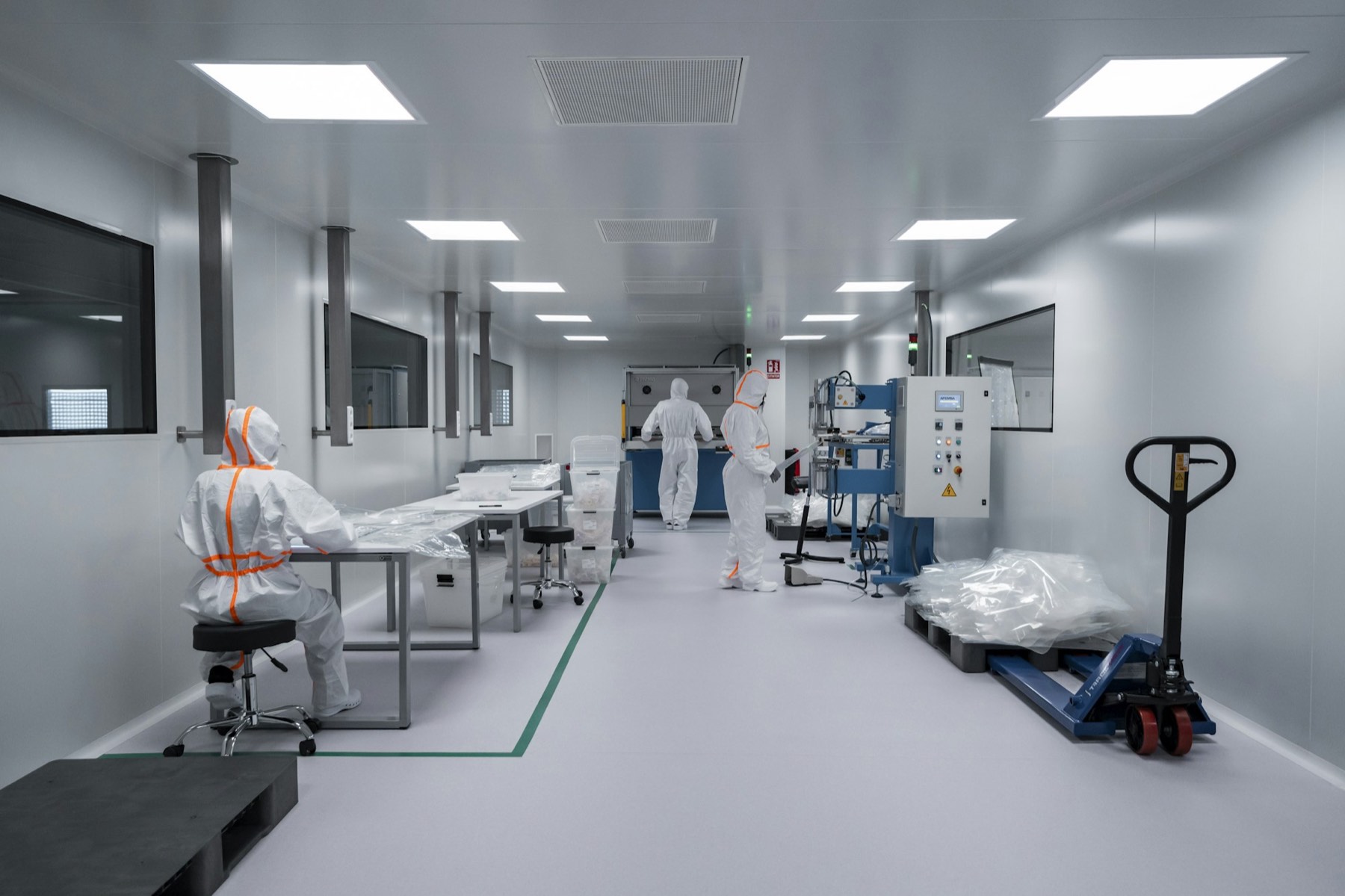
Where the moulding machines stand
There are three layouts to compare. None is required by a standard; the choice follows your risk assessment, the parts and the building.
| Layout | What is inside the clean area | Trade-offs to check |
|---|---|---|
| Whole machine inside the room | Machine, mould, part handling and operators | Simplest to describe; all machine heat and any oil mist go into the room air; largest clean volume |
| Mould area under a clean zone | Only the mould and part take-off sit under filtered air, often a softwall or hardwall enclosure with FFUs; the machine body stays in the general hall | Smaller clean volume and less heat in the clean air; the enclosure must prove its class by particle count; the joint between enclosure and machine needs detailing |
| Machine through the wall | Machine body outside; the mould end and part discharge open into the cleanroom through a sealed wall opening | Keeps the machine body out of the room; the wall opening, access for mould changes and sealing need design |
For a clean zone or booth, remember that a softwall enclosure can claim only the class a particle count proves under ISO 14644-1. We found no standard that assigns a class to softwall booths. See softwall and portable cleanroom booths and hardwall vs softwall.
Heat load sets the air volume
Moulding machines heat the room: barrel heaters, hydraulic or electric drives, and hot moulds. In a cleanroom, equipment heat can set the supply air volume before particle control does.
To see the scale, use the sensible-heat balance for air (density about 1.2 kg/m³, specific heat about 1.0 kJ/kg·K): heat removed in kW is about the airflow in m³/h, times the temperature rise in K, divided by 3,000.
Worked example, assumed values only: if machines release 20 kW into the room and the supply air may rise 8 K, the air needs about 20 × 3,000 ÷ 8 = 7,500 m³/h for cooling alone. If particle control needs less, heat sets the airflow, and the air system must cool that much air. Use the real heat figures from your machine supplier.
Ways to reduce the heat in the clean air:
- keep the machine body or its hydraulic unit outside the clean area (see the layouts above);
- put chillers and temperature control units outside the room, with piped connections;
- ask for a separate cooling load for each machine on the room data sheet.
Hold the room temperature and humidity your process and regulator need. The NMPA sterile device annex gives 18 to 28 °C and 45 to 65% relative humidity where there is no special process need (clause 2.2.11). See cleanroom temperature and humidity and cleanroom HVAC design.
Resin, parts and people
Resin. Plan how resin enters: through a material airlock or pass-through, or by a closed conveying line from a dryer outside the room. Decide where outer bags and cartons are opened or wiped, so they stay out of the clean side.
Parts. Plan the route from the mould to the bin, to inspection, to packing, so finished parts do not cross the path of incoming material or waste. If parts go to a separate assembly or packing room, use a pass box or material airlock between them. See pass boxes.
People. Operators enter through a gowning room. Our industry page lists gowning at ISO 8 as a typical class. Mould changes and maintenance bring tools and technicians into the room; plan that route and its cleaning steps too. See gowning room design.
Pressure. Step the pressure from the cleanest room down to the hall. The NMPA sterile device annex asks for more than 5 Pa between rooms of different class and more than 10 Pa to the outdoors, with a pressure indicator (clause 2.2.2). Our industry page also flags doors that open toward the less clean side as a common mistake (clause 2.2.14). See cleanroom pressure differentials.
Walls, ceilings and cleaning
Device rooms need smooth, cleanable wall and ceiling finishes, sealed joints and sealed penetrations for the machine services (power, cooling water, compressed air, resin lines). Plan every service penetration in the panel layout so it is cut and sealed as part of the envelope. See cleanroom wall and ceiling finishes.
Testing the finished room
The classification test is a particle count to ISO 14644-1, in the occupancy state you set. You can classify the room at rest first, then in operation with the machines running. The NMPA annex lists routine monitoring of particles, microbes, air changes or velocity, pressure, temperature and humidity (clause 2.7.3). The device maker's quality team approves the results. See ISO 7 and ISO 8 cleanroom requirements and validation and handover.
What to send for a quote
| Send | Why |
|---|---|
| Device list, with contact type and sterile status | Sets the class with your risk file |
| Process steps: moulding, cleaning, assembly, packing, sealing | Sets which rooms are clean and at what class |
| Target class and occupancy state per room | The design and the test target |
| Machine schedule: number, size, footprint, layout choice | Room size and enclosure type |
| Heat released into the room per machine | Air volume and cooling |
| Chiller, dryer and hydraulic unit positions | What stays outside the clean area |
| Resin supply method and part route | Airlocks, pass boxes, layout |
| Operators per shift and maintenance access | Gowning size and routes |
| Target markets and regulators | Which rules apply |
| Floor plan and ceiling height of the building | Panel layout and service routes |
Mark anything not yet known as "to confirm". Our room list builder takes about five minutes. We supply the panels, doors, windows and air equipment, and can design and build the room under one contract; see medical device cleanrooms.
Questions
Common questions
What ISO class is needed for injection moulding of medical devices?
ISO 7 or ISO 8 is the common range, but the class comes from your risk assessment and your regulator. China's NMPA annex for sterile devices, for example, sets Class 10,000 (ISO 7) as the minimum for devices implanted or placed in blood vessels.
Must the whole moulding machine be inside the cleanroom?
No standard says so. Some layouts keep the machine body outside and put only the mould area under a clean zone, or bring the mould end through the wall. Whatever the layout, the clean area must prove its class by a particle count.
Why do moulding cleanrooms need so much air?
The machines release heat. In many moulding rooms, removing that heat sets the supply air volume before particle control does. Keeping drives and chillers outside the room lowers the load.
Is a softwall booth over the mould enough?
It can be, if your risk file accepts it and a particle count proves the class. No standard assigns a class to softwall booths, so test it in the state you will run.
Is ISO 13485 a cleanroom standard?
No. ISO 13485 is a quality management standard for device makers. It asks the maker to define and control its work environment and design inputs; the cleanroom class itself comes from the maker's risk file and market rules, and is tested to ISO 14644-1.
Related guides
- How to Import a Cleanroom from China
- Writing a cleanroom URS: contents and testable wording
- How long does it take to build a cleanroom?
- How to choose a cleanroom contractor: questions and evidence
- Turnkey cleanroom contractor
- Room list builder
Sources
- NMPA, Medical device GMP appendix: Sterile medical devices, Announcement 2015 No. 101
- NMPA Announcement 2025 No. 107, revised medical device GMP, in force 1 November 2026 (Hong Kong Trade and Industry Department circular)
- FDA, Quality Management System Regulation (QMSR)
- ISO 13485:2016, Medical devices: Quality management systems (ISO)
- ISO 14644-1:2015, Part 1: Classification of air cleanliness by particle concentration (ISO)
Project enquiry
Send what you have
A room list, a floor plan or only the floor area is enough to start. After you submit, send drawings by email or WhatsApp.
We reply by email within one working day. We can sign an NDA before you send drawings.
WhatsApp +44 7962 561184 is our UK number for export enquiries. The factory is in Tianjin, China.
Email: [email protected]
WhatsApp: +44 7962 561184