
Updated · ZY Cleanroom
A cleanroom classification requirement must be clear enough for the project team to design, quote and test the intended room. Writing an ISO class number alone leaves important questions about room use, operating conditions and acceptance responsibilities unanswered.
What ISO 14644-1 classifies
ISO 14644-1 concerns air cleanliness measured by airborne particle concentration in cleanrooms and clean zones. It is not a fire rating for sandwich panels or a product certificate for a door. The official ISO scope is the reference for the classification standard.
ISO 5 vs ISO 7 vs ISO 8: Reading a Classification Reference
At the same particle-size threshold, a lower ISO class number corresponds to a lower particle concentration. The three examples below use the airborne-particle columns in FDA Table 1, a published aseptic-processing reference.
ISO Class 5
- FDA table reference
- 3,520 particles/m³
- Older class label in that table
- Class 100
ISO Class 7
- FDA table reference
- 352,000 particles/m³
- Older class label in that table
- Class 10,000
ISO Class 8
- FDA table reference
- 3,520,000 particles/m³
- Older class label in that table
- Class 100,000
Source: FDA aseptic-processing guidance (2004), Table 1, printed page 5. These are the table’s >0.5 µm particle references and legacy labels, rather than a reproduction of the full ISO classification standard or its sampling procedure.
For an RFQ, state the required standard, particle-size criteria and occupancy state explicitly. An old class label alone does not define the full acceptance requirement. Pharmaceutical process controls and microbiological monitoring require their own applicable criteria.
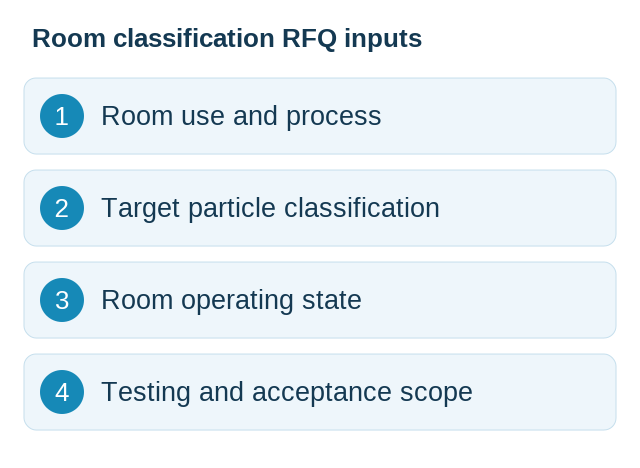
Prepare the room requirements for your RFQ →Include these classification inputs
| RFQ field | Information to provide |
|---|---|
| Room and process | What takes place in each room, with the layout and process requirements |
| Target classification | The required class and applicable particle-size criteria from the project specification |
| Assessment conditions | The operating or occupancy conditions under which acceptance will be assessed |
| Related conditions | Required temperature, humidity, pressure relationships and other process needs |
| Acceptance | Who defines the test procedure, performs testing and accepts the results |
A panel thickness does not establish a room class
The enclosure, air systems, room use and acceptance testing need to be addressed together. Choosing a 50mm or 75mm panel does not establish the cleanliness class of the completed room. Provide separate requirements for the panel assembly and the room's performance.
A class number does not define every airflow parameter
Do not use a general article's air-change estimate as the design specification. Ask the project designer to explain the proposed airflow arrangement, filtration, pressure relationships and controls for your process and layout. Have those requirements reflected in the quotation and design documents.
Classification and regulatory requirements are separate questions
An airborne particle classification alone does not prove all requirements for a pharmaceutical, food or laboratory operation. Provide the project standards and process requirements established by your responsible technical team. Ask the quotation to identify which design, testing and documentation tasks are included.
Use the cleanroom project RFQ checklist to connect room classification with the enclosure, equipment, site interfaces and acceptance scope. Send the specification through our inquiry form for a project-specific review.
Browse all cleanroom knowledge articles
Download the classification and acceptance RFQ checklist (TXT, English)