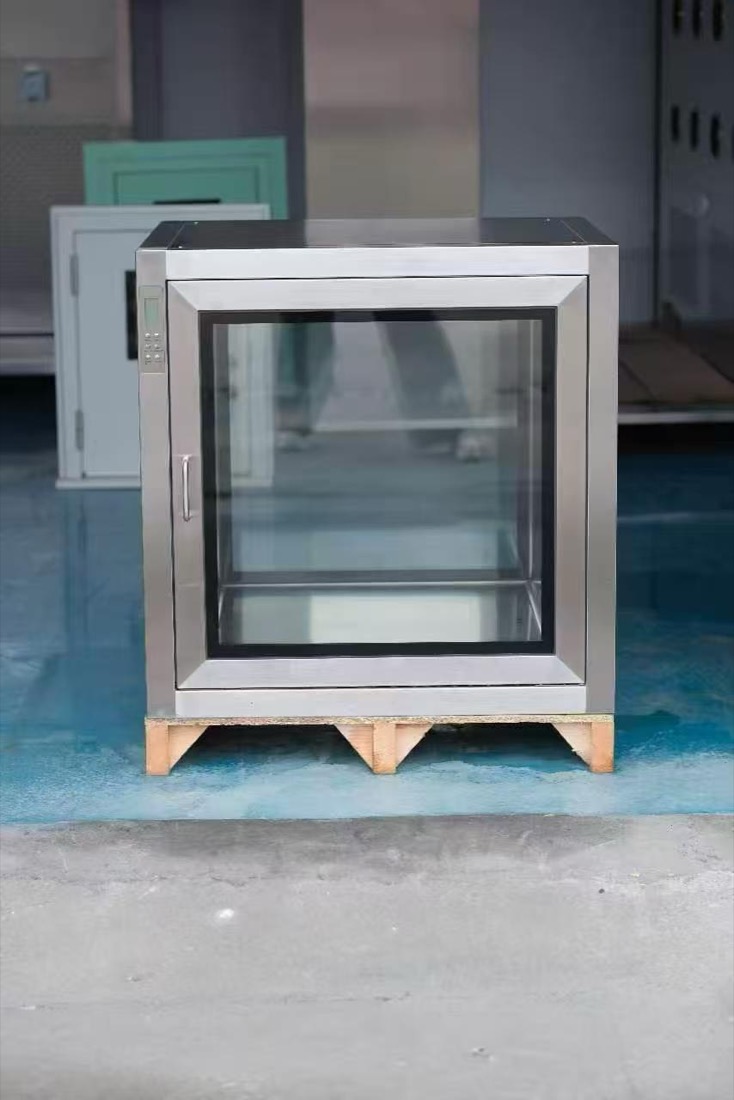
Cleanroom Pass Boxes
A cleanroom pass box, also called a pass-through box or transfer hatch, is a wall-mounted chamber with interlocked doors for moving materials between zones without opening the room. Buyers specify static, dynamic or VHP versions around the transfer task.
Best for
- Material transfer between cleanroom zones
- Pharmaceutical and laboratory transfer points
- Trolley transfer at floor level
- Items that need a decontamination cycle during transfer
Specifications
Typical specification
| Types | Static (passive), dynamic (active), VHP decontamination, floor-standing transfer unit |
|---|---|
| Form | Wall-mounted chamber with interlocked doors |
| Static type | Generally no active filtered-air treatment |
| Dynamic type | Defined air-treatment arrangement, described for the offered model |
| VHP type | Cycle-specific validation evidence is requested for your load |
| Sizes to give | Largest load (W × H × D) including packaging; usable chamber and clear opening; wall thickness and installation opening; loading height |
| Service space | Door swing or lift clearance, trolley approach, access to filters, controls and utilities |
| Tests | Filter, airflow, interlock or other tests agreed in the quotation |
| Body material | Stated for the offered model in the quotation. Tell us if the chamber must be stainless steel, and which cleaning agents are used |
| Supply | Supplied with your panels and doors in one quotation, so sizes and openings match; each unit is inspected before shipping |
Options
What you can specify
- Static pass box
- Dynamic pass box
- VHP decontamination pass box
- Floor-standing transfer unit for trolleys
- Interlock and control interface to your schedule
How to choose a pass box
Specify by the transfer task. A static box moves items through a boundary. A dynamic box adds a defined air-treatment arrangement. A VHP box runs a decontamination cycle during transfer. A floor-standing unit takes trolleys. Neither the word static nor dynamic proves particle removal or sterile transfer.
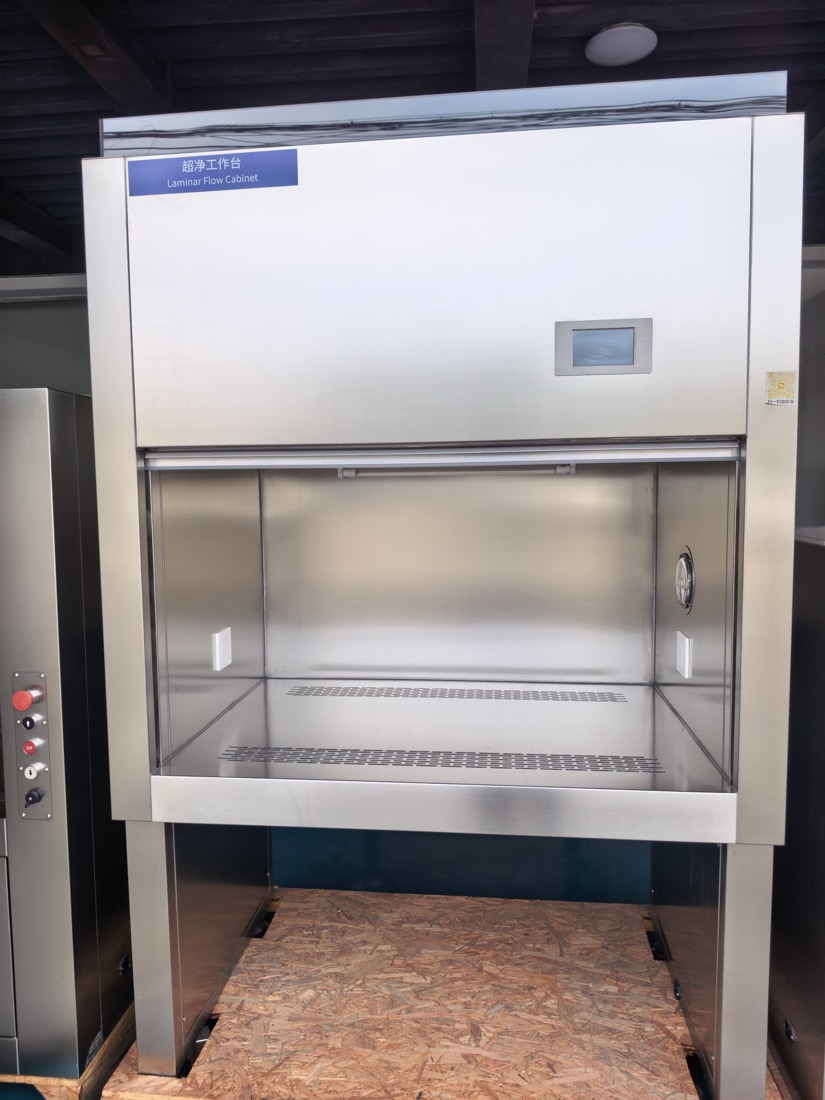
Clean benches serve a work area, not a transfer, so specify them separately.
Pass box types: static vs dynamic, VHP and floor-standing
| Static | Dynamic | VHP | Floor-standing | |
|---|---|---|---|---|
| Air supply | None | Fan and HEPA filter flush the chamber | Decontamination cycle | As specified |
| Power | Interlock only | Fan, controls, interlock | Generator, controls, utilities | As specified |
| Filter to test and replace | No | Yes | As specified | As specified |
| Typical transfer | Small items between rooms of similar risk | Into a cleaner room where shedding is a risk | Items that need surface decontamination | Trolleys at floor level |
| Ask for | Interlock check | Filter class, airflow, leak test access | Cycle validation for your load | Floor interface and threshold |
No standard we checked sets an air velocity for a dynamic pass box. State the speed and the measuring point in your specification and confirm them by test; see dynamic pass box air velocity.
Where pass boxes are used: pharma, hospitals and laboratories
| Where | What the pass box does there | Read more |
|---|---|---|
| Pharmaceutical cleanroom | Moves materials into a higher grade: interlocked into Grade A and B, at least a visual or audible warning into Grade C and D (EU GMP Annex 1, para 4.13) | Pharmaceutical cleanroom zoning |
| Pharmacy compounding suite | Under USP <797>, pass-through doors must never open together and should interlock | USP 797 compounding cleanroom |
| Hospital operating theatre | A pass-through hatch is part of a typical modular theatre package | Modular operating theatre |
| QC, microbiology and biosafety laboratory | Interlocked doors and pass boxes between zones with their own air and pressure; in biosafety labs, two-sided pass boxes are interlocked | Cleanroom laboratories |
The room name does not choose the type. Static, dynamic or VHP still comes from your risk assessment and the transfer list.
How a pass box works: operation procedure, step by step
| Step | What happens |
|---|---|
| 1 | On the outer side, open the door; the inner door is locked. |
| 2 | Wipe the item as your procedure requires, place it in the chamber and close the door. |
| 3 | Dynamic box: the fan flushes the chamber with HEPA-filtered air for the set time. VHP box: the decontamination cycle and aeration run. Static box: no air step. |
| 4 | The interlock releases the inner door once the outer door is closed and any delay or cycle has ended. |
| 5 | On the clean side, open the inner door, take out the item and close the door. |
EU GMP Annex 1 para 4.13 says the entry and exit doors should not be opened at the same time, and para 4.12 asks that pass-through hatches protect the higher-grade side, for example by flushing with filtered air. The interlock guide covers delays, power cuts and tests; see also VHP pass boxes and static or dynamic pass box.
GMP rules for pass boxes
| Rule | Source |
|---|---|
| The two doors must not open at the same time | USP <797>; EU GMP Annex 1 para 4.13; GB 50073-2013 term 2.0.22 |
| Interlock for transfers into Grade A and B | Annex 1 para 4.13 |
| Visual or audible warning, at least, into Grade C and D | Annex 1 para 4.13 |
| Time delay between doors, where needed | Annex 1 para 4.13 |
| Protect the higher grade, for example by flushing with filtered air | Annex 1 para 4.12 |
| Only items on an approved list into Grade A or B | Annex 1 para 4.12 |
None of these texts requires a dynamic box in every case. Annex 1 gives flushing as an example; the choice stays with your risk assessment. China's pass box standard, JG/T 382-2012, sorts boxes by function: basic, purification, disinfection, negative pressure and airtight. State the function you need in your URS.
Size the chamber from the load
- Take the largest item on your transfer list, in its packaging or tray, W × H × D.
- Add room to wipe it and to handle it with gloved hands.
- That gives the usable chamber. The clear door opening must pass the item too.
- The external size then follows from the model. Keep chamber, clear opening and external size as three separate numbers with units.
- Check the installation opening against the wall thickness and the loading height on both sides.
Pass box specification checklist
Send four measurements. First, the largest transfer load, including packaging, trays or the trolley. Second, the usable chamber and clear openings. Third, the wall and floor interface: partition thickness, installation opening, loading height and threshold. Fourth, operating and service space. State units on every dimension. Add the type, interlock and control needs, required tests, quantity and destination.
A data-sheet line, filled in
| Field | Example |
|---|---|
| Mark | PB-01 |
| From / to | Grade C corridor to Grade B room |
| Type | Dynamic |
| Largest load with packaging | W × H × D, mm |
| Usable chamber | W × H × D, mm |
| Wall | 50 mm panel wall |
| Loading height | Bottom of chamber above floor, mm |
| Interlock | Doors not open together; delay set by the process |
| Final filter class | To confirm, EN 1822 class |
| Tests | Interlock check, airflow, filter leak test |
| Voltage and frequency | Site supply |
For DQ, IQ, OQ and PQ of a pass box, see pass box qualification.
What goes wrong on site
Internal chamber size and external unit size get mixed up, and the load does not fit. A VHP label is treated as proof of a validated cycle, when the cycle must be validated for your load.
Door swing, trolley approach and filter access also need room. Agree the transfer procedure and the acceptance tests with the project team before ordering. Ask for the utility schedule, and whether connection to site systems and commissioning are included.
Static vs dynamic pass box: how to choose
Questions
Common questions
What is a pass box?
A pass box is a hatch in a cleanroom wall with a door on each side; one door cannot open while the other is open. A static pass box has no air supply of its own; a dynamic one adds a fan and a HEPA filter that sweep the chamber with filtered air.
What is the working principle of a pass box?
Two doors that cannot open together make the box an airlock for materials. Items are loaded from one side and taken out from the other. A dynamic box adds a filtered-air flush between the two steps; a VHP box adds a decontamination cycle.
What is a static pass box?
A wall hatch with two doors that do not open at the same time, with no fan or filter. It is chosen for passing small items between rooms of similar risk, where wiping the items is enough.
What is a pass box used for?
To move materials, samples and tools into or out of a cleanroom without people walking through and without opening the room to the corridor. Pass boxes are used in pharmaceutical cleanrooms, pharmacy compounding suites, operating theatres and QC, microbiology and biosafety laboratories.
What is a pass box with a buffer chamber?
It usually means a material airlock: a chamber with interlocked doors that large loads or trolleys pass through. The EU GMP Annex 1 glossary calls a pass-through hatch a synonym for an airlock, though usually smaller. Send the size of the largest load with its packaging or trolley, and we propose the version.
What is the difference between a static and a dynamic pass box?
A static box generally has no active filtered-air treatment. A dynamic box uses a defined air-treatment arrangement that must be described for the offered model. Neither name alone proves particle removal or sterile transfer.
When is a VHP pass box used?
When items must go through a decontamination cycle during transfer. Specify load dimensions, material compatibility, utilities and the decontamination process, and request cycle-specific validation evidence.
Which dimensions should I send?
The largest item or trolley with packaging, usable chamber and clear opening, wall thickness, floor or loading height, door movement and service space. Keep chamber dimensions apart from external unit dimensions.
What tests and documents should the quotation include?
Agree equipment identification, drawings, operating instructions and the filter, airflow or interlock tests that apply. For a VHP process, define the load and cycle validation scope separately. Confirm what is done at the factory and what on site.
Do pass box doors have to be interlocked?
For transfers into Grade A and B areas, EU GMP Annex 1 para 4.13 asks for an interlock. Into Grade C and D, a visual or audible warning is the minimum. USP <797> says the two doors should never open at the same time and should interlock.
What does a pass box controller and display do?
The controller reads the door sensors, drives the door locks, runs the delay and any fan or decontamination cycle, and shows the door status on both sides. State the delay, the indicator lights and the power-cut behaviour in the data sheet; see pass box interlocking system.
How often should a pass box be cleaned?
The texts we checked set no cleaning interval: your cleaning procedure sets it. Items are still cleaned and disinfected before they pass into a higher grade (EU GMP Annex 1, para 4.12). For pharmacy compounding, USP <797> asks for surface sampling at least monthly for Category 1 and 2; see static or dynamic pass box.
Can I get a pass box drawing?
Ask for a dimensioned drawing of the offered model with the quotation. It should show the usable chamber, clear door opening, external size, wall opening and loading height, so you can check it against your wall before ordering. The step table above shows how the doors and the air step work.
Does a dynamic pass box replace wiping the items?
No. Annex 1 still asks for cleaning and disinfection of items moving into higher grades, in line with the risk. The air flush protects the cleaner room during the transfer.
What drives the price of a pass box?
The specification: chamber size, type (static, dynamic or VHP), material and finish, door type, interlock and controls, and the tests and documents you ask for. To compare offers, send every supplier the same data sheet; see also what moves the cost of a dynamic pass box. We supply pass boxes in the same quotation as the panels and doors, each unit is inspected before shipping, and the price is confirmed in a written quotation.
Do you supply pass boxes for projects outside China?
Yes, as part of a cleanroom project. Pass boxes are in one quotation with the panels and doors, so the openings and wall thickness match, and each unit is inspected before shipping from Tianjin. Tell us the project city.
Project enquiry
Send what you have
A room list, a floor plan or only the floor area is enough to start. After you submit, send drawings by email or WhatsApp.
We reply by email within one working day. We can sign an NDA before you send drawings.
WhatsApp +44 7962 561184 is our UK number for export enquiries. The factory is in Tianjin, China.
Fastest reply: message us on WhatsApp. Or use the form, and add your WhatsApp number so we can reply there.
Email: [email protected]
WhatsApp: +44 7962 561184